

How AI-moderated research interviews work, from brief to delivered clips
The AI moderator runs each interview. Your team keeps the questions and the decision, with a review between batches in the middle.

Key takeaways
- The discussion guide sets the ceiling on depth, so its probe rules and stop rules deserve as much care as its questions.
- Participant verification needs two layers, one before the interview and one during it, and a provider should show you both in writing.
- Translation and dubbing decide whether a multi-market study can be compared at all, so ask for a sample before any pilot.
- Human moderators still serve best where participant welfare is at stake or where nobody yet knows which questions matter.
- The output worth paying for links every finding to the participant saying it on video rather than to a summary line.
- Echovane runs the whole study for you, from guide to clip-backed deck, with real, verified people across 90+ countries and 65+ languages.
A launch brief that spans 10 markets and leaves six weeks on the clock usually forces a trade between depth and coverage. AI-moderated research interviews are built to ease that trade.
With this method, an AI moderator holds a qualitative interview with each real participant and writes every follow-up from their answers, with many conversations running in parallel. That places the method between a static survey and a human-moderated interview. The AI does the interviewing itself, which sets it apart from tools that assist a person or screen job candidates.
This guide follows one such brief, from a hypothetical beverage brand testing three drink concepts (early product ideas shown to target buyers) across 10 markets. Speed only helps if the depth holds. Each stage below shows where that depth comes from, followed by questions for any provider and one managed study run end to end.
What AI-moderated research interviews are
An AI-moderated research interview is one where the AI conducts the whole conversation with the participant. It puts the guide's questions to each participant and follows up on unexpected answers, returning to anything that contradicts an earlier point while keeping the session on pace. A human team designs the guide and reviews the outputs, then makes the analytical calls.
1. What they are not
It is not AI-assisted moderation. If a human moderator runs the live session and software only suggests questions or takes notes, the method counts as AI-assisted.
It is not a job-screening tool either. AI interview software for hiring scores candidates against a role, while a research interview asks consumers about their lives and their choices.
And it is not synthetic respondent research, because every interview here is with a real person. Synthetic respondents can serve quick, early screening, such as narrowing 10 concepts down to 3. Interviews with real people carry the decisions that have money behind them.
2. Where they sit between surveys and human-moderated interviews
A static survey follows fixed branches, and an unexpected answer gets no follow-up. Human moderators follow every thread worth following, though each one handles a single session at a time, in one time zone.
AI moderation sits between the two. It keeps one guide across every session and still probes each answer, so the 10-market test gets the same core interview in each language.
Depth can hold at that scale. In a randomized study of 41 text-chat interviews from October 2026, AI interviewers asked more than twice as many questions as trained non-expert interviewers.1 They also drew roughly 65% more text from participants, who were university students using text chat.
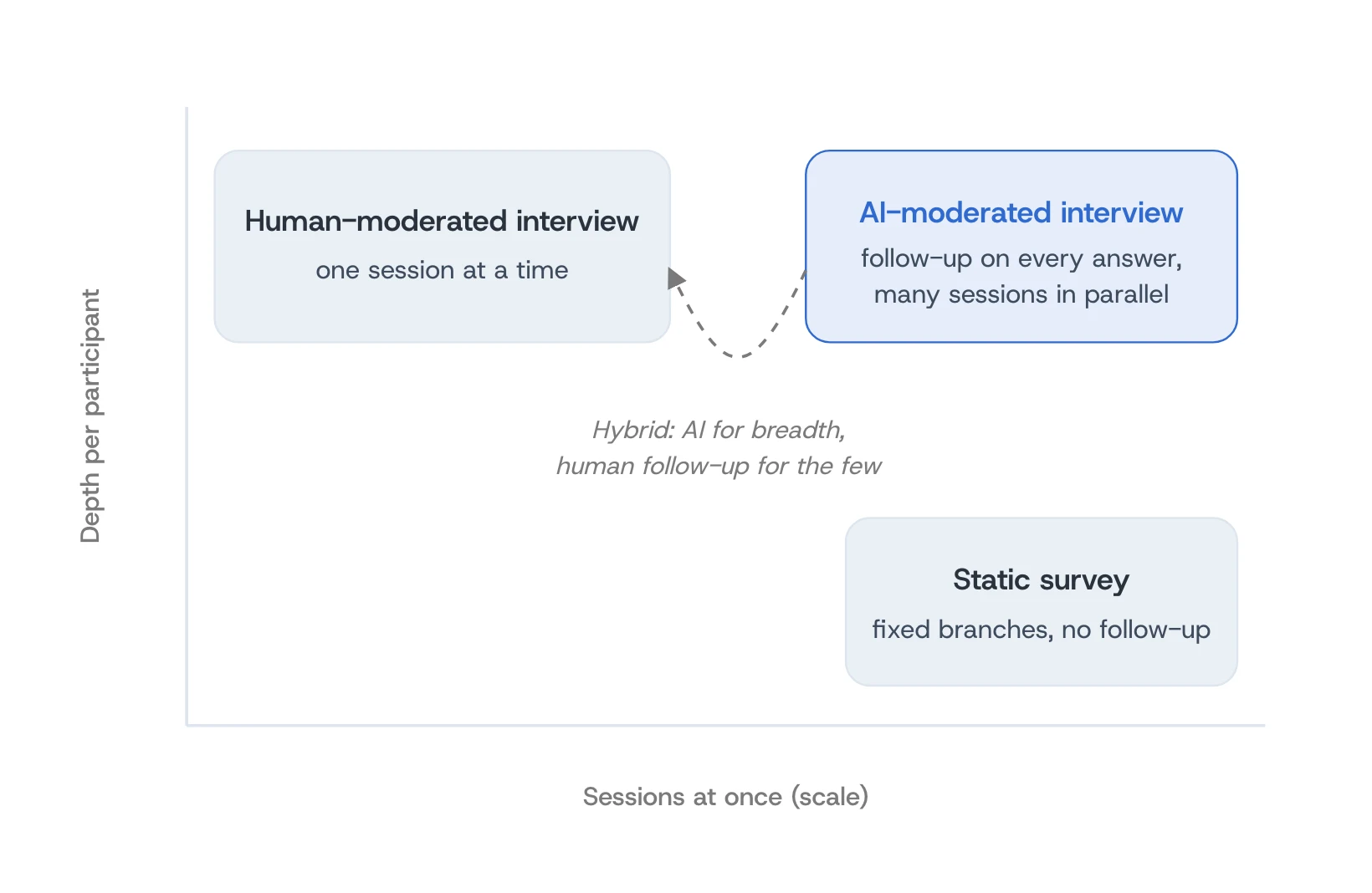
Read figure details
- Label 1
- Sessions at once (scale)
- Label 2
- Depth per participant
- Label 3
- Human-moderated interview
- Label 4
- one session at a time
- Label 5
- AI-moderated interview
- Label 6
- follow-up on every answer,
- Label 7
- many sessions in parallel
- Label 8
- Static survey
- Label 9
- fixed branches, no follow-up
- Label 10
- Hybrid: AI for breadth,
- Label 11
- human follow-up for the few
| Area | Static survey | AI-moderated interview | Human-moderated interview |
|---|---|---|---|
| Who asks follow-ups | Nobody, as branches are fixed | The AI moderator, from each answer | The moderator, from instinct and rapport |
| Depth per participant | Short answers | Goes as deep as the guide's probe rules allow | Deepest, though quality shifts from one moderator to the next |
| Sessions at once | Thousands | Many in parallel | One |
| Best use | Sizing known answers | Depth across many markets or segments | Sensitive or open-ended work |
The methods also combine well in one study, with AI interviews covering breadth across markets. A human moderator then follows up with the few participants whose answers need a live conversation.
When AI-moderated interviews are the right method
AI moderation earns its place when a study needs consistent depth across many markets or languages, and the topic carries no special risk to participants. Human moderation earns its place when rapport and judgment in the moment decide the quality of the answer.
The decision framework can be turned into four questions, given in the figure below. One common criticism is that AI interviews squeeze open-ended work into a single pass. A review after the first batch, or a human follow-up round, usually addresses that concern.
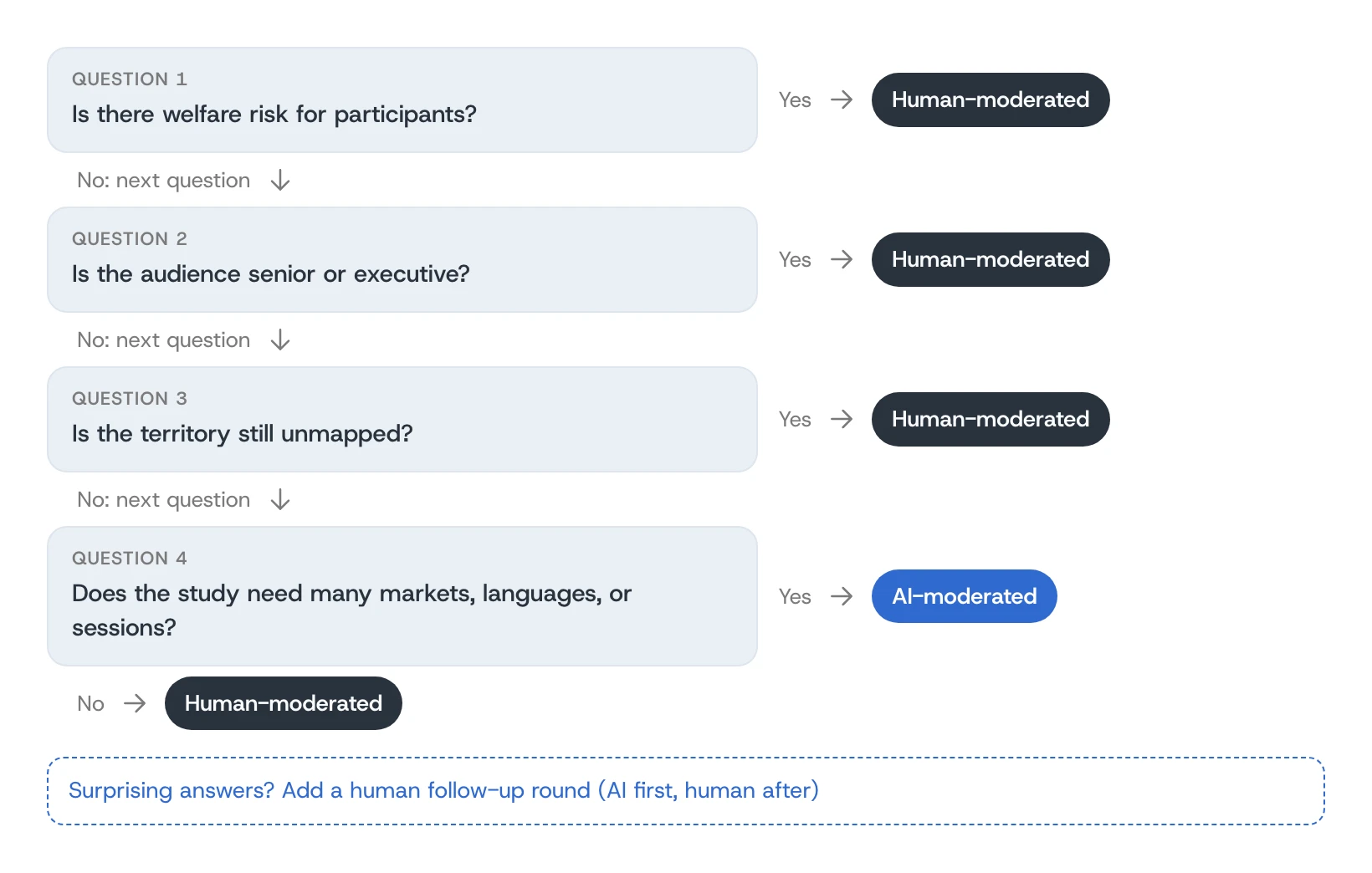
Read figure details
- Question 1: Is there welfare risk for participants?
- Yes: Human-moderated
- Question 2: Is the audience senior or executive?
- Yes: Human-moderated
- Question 3: Is the territory still unmapped?
- Yes: Human-moderated
- Question 4: Does the study need many markets, languages, or sessions?
- Yes: AI-moderated
- No
- Human-moderated
- Surprising answers? Add a human follow-up round (AI first, human after)
- Surprising answers? Add a human follow-up round (AI first, human after)
1. Studies where AI moderation adds the most
The method pays off where a study needs the same depth many times over. It does its best work in these cases.
- Multi-market studies: One guide runs in each participant's language and time zone, so in the concept test, the nine markets follow the first review field in parallel.
- High-volume validation: Dozens to hundreds of interviews for concept and pack tests, or for studies of why buyers lapse.
- Switching and win/loss studies: Jobs-to-be-done interviews (research into the progress a buyer wants when they switch products), plus win/loss reviews in B2B.
- Follow-up on survey scores: Asking participants why they gave a rating after a quantitative study.
- Candid, low-risk topics: Personal habits or money, where talking to software can feel less like being judged. Treat that as a comfort benefit to test in your pilot.
- Niche segments: Audiences that need broad recruitment reach before anyone can interview them.
- AI first, human after: Broad AI interviews, then live human follow-ups with the participants whose answers surprise.
2. Studies a human moderator should run
Some studies still need a person in the moderator's seat, because the conversation itself needs care or judgment at the moment. Keep these with a human moderator.
- Topics with welfare risk: Trauma or serious illness, where a trained person protects the participant.
- Senior and executive interviews: People who expect a peer conversation and give their time on those terms.
- Unmapped territory: In a randomized MeasuringU study of 20 participants, people volunteered more than twice as many unprompted facts to human moderators, 2.5 against 1.0 per session.2 That difference came from details nobody asked about, which a guide cannot plan for.
- High-rapport sessions: Conversations where trust builds over the session and shapes what people share.
- Live redirection: Studies where you want to watch and redirect the moderator in the moment. Changes to an AI-moderated study wait for the next batch.
Text and audio-only tools can also miss non-verbal cues and sarcasm. Some AI moderators analyze tone of voice and facial expression on video, which narrows that, and watching the flagged clips catches the rest.
How an AI-moderated study runs, stage by stage
An AI-moderated study runs in seven stages, and the AI moderator runs one of them, the interviews. AI tools help with transcripts and themes afterward, while people write the guide and review the first batch, then turn the findings into a story for the business. The 10-market concept test runs through them in this order.
- Guide and screener
- Recruitment and verification
- The interviews
- First-batch review
- Transcripts and translation
- Themes and clips
- Deck and dashboard
Stages 1 to 4 are explored below, while stages 5 to 7 sit under the analysis section.
1. Turning the business question into a guide and screener
The discussion guide (the script of questions and follow-up rules the AI moderator works from) starts from the business question, not from a template. Here, the concept test's question might be which of three drink concepts earns a place in the launch plan, and why.
Each question in the guide carries rules for the AI moderator. A probe rule says where to dig deeper, and a move-on rule says when an answer is enough. A stop rule caps follow-ups and time, and it gives a distressed participant a clean way out.
Sample guide question (hypothetical): "Tell me about the last time you chose a drink for the afternoon." If the answer names a brand, the probe rule asks what made it the default. The move-on rule ends the question after one specific occasion, and the stop rule caps it at three follow-ups.
The screener (the short set of qualifying questions that filters who takes part) needs the same care, because a loose one recruits the wrong people. The risk grows when few people qualify, as with any screener for niche audiences. Closed questions in the guide cause a quieter problem, keeping the AI at surface level and producing thin transcripts.
Dry-run the full guide before the first batch, because a test run is the cheapest place to catch over-probing and a guide that runs long. Run it with a few colleagues as participants, and read every transcript before fieldwork starts.
2. Recruiting and verifying participants
Recruitment starts from a profile written as behavior you can check. The concept test might recruit adults who bought a ready-to-drink beverage in the last two weeks and switched brands at least once in three months.
Panel recruitment and specialized fieldwork find those people, and verification then runs in two layers. A session has to clear both before it counts.
- Before the interview: Screener authenticity, IP and location, identity and phone, duplicate accounts, VPN and proxy, live human voice, and human-written responses.
- During the interview: Response quality, engagement, contradictions, and genuine category experience.
Participants should also be told up front that an AI moderator will run the interview. Explicit consent comes before each interview starts.
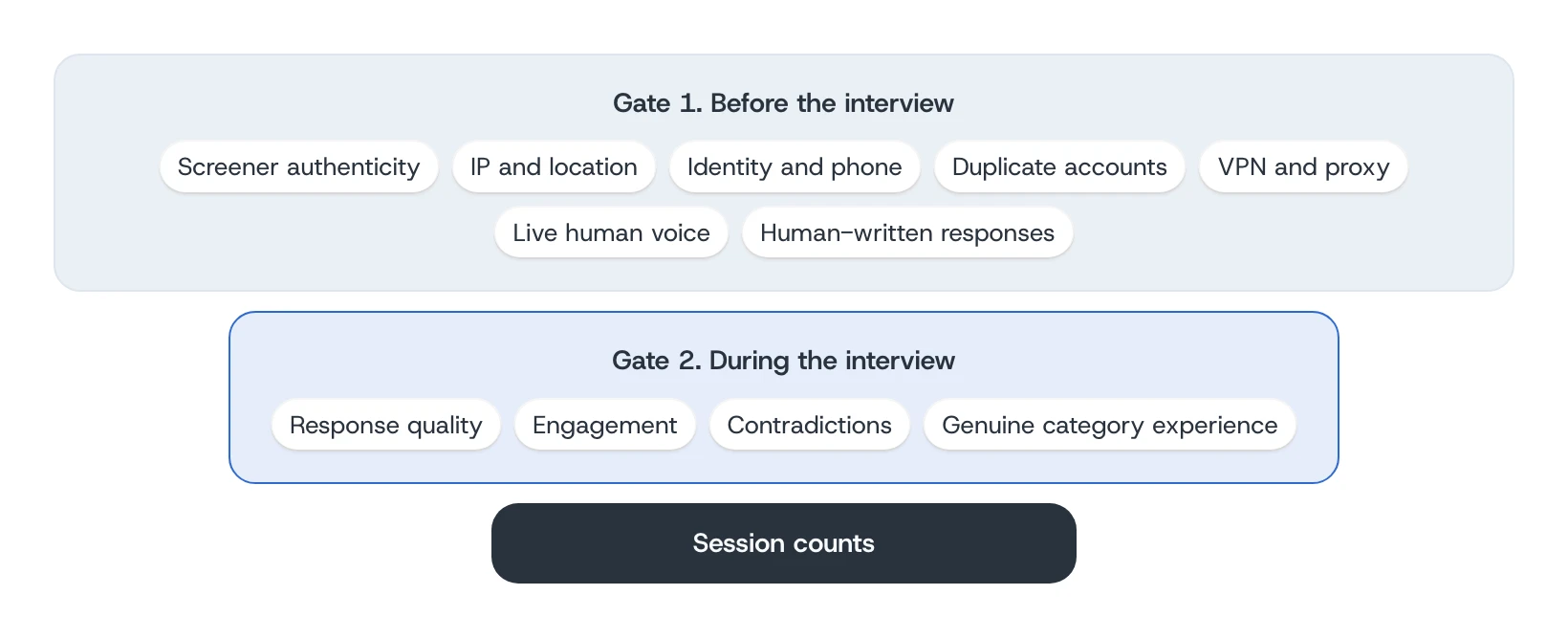
Read figure details
- Gate 1. Before the interview
- Screener authenticityIP and locationIdentity and phoneDuplicate accountsVPN and proxyLive human voiceHuman-written responses
- Gate 2. During the interview
- Response qualityEngagementContradictionsGenuine category experience
- Session counts
- Session counts
How to test it: Ask any provider what it checks before the interview and what it checks during it. A provider that answers only one half stops at screening people without verifying them.
3. What happens inside each interview
Participants join by voice or video at a time they choose, and some tools also offer text. The AI moderator opens the conversation and works through the guide, writing each follow-up from the participant's own words.
It also watches for conflicts across the conversation. In the concept test, a participant says early on that sugar content decides every drink they buy. Twenty minutes later, they pick the most indulgent concept, and the moderator brings back the earlier answer and asks what changed.
Pacing matters as much as probing, so the moderator tracks the time each section of the guide allows. Every section gets covered, and the moderator moves on once an answer meets its move-on rule.
Session length is a setting to ask about, since the method itself sets no fixed limit. Some AI moderators can sustain long sessions and recall earlier moments of the conversation, which is where contradiction checks pay off most. Probing like this is one of the clearest tests of what separates AI research partners.
4. Reviewing the first batch before the rest run
Changes to a running study wait for the next batch, so the review after the first one does the steering. You watch the early recordings through the dashboard and flag changes to the guide or screener. The guide is updated before the next batch runs.
Market 1 runs first in the concept test. The review shows participants comparing concept B with a drink they already buy, so the team adds a question on which product it would replace. Markets 2 to 10 then run with that question in place.
Treat this as quality control, the same discipline any rigorous method uses. Interviews run as set once they start, so plan the review time into the schedule from the first day. The same goes for studies that run one brief across several research methods, where interviews sit alongside other work.
“In a multi-market study, the change I see most often after the first batch is local phrasing. We run interviews in each participant's own language, and a benefit word that sounds natural in English can feel stiff or clinical elsewhere. When our researcher and the client watch the early clips, you hear people hesitate and ask what the phrase means. We update the guide to use the everyday term from those recordings, then run the remaining markets.”
Smriti Gupta, CEO, Echovane
What the analysis stage delivers
The test of an analysis stage is whether a stakeholder can act on its output without reading a transcript. A transcript dump fails that test, and a set of themes tied to the participant's own words passes it. Three outputs carry the weight, covered below.
5. Transcripts and translated sessions
Transcripts come from the recordings, timestamped so each line links back to its moment in the video. Sessions in a 10-market study run in each participant's language, so translation decides whether the team can compare markets at all.
Good translation carries over the slang and hedges along with the meaning. English dubbing goes a step further, so a brand manager in London can watch a session from Jakarta in English. The pause before an answer survives too, and it often shows what consumers cannot put into words.
How to test it: Before a pilot, ask for a sample transcript and a dubbed clip from a non-English session. Check whether the translation keeps the hedges along with the words.
6. Themes with every finding traced to a clip
Themes come from patterns across transcripts, and each theme should carry clips as proof. A stakeholder then goes from a finding to the participant saying it in one click.
One theme from the concept test might say that concept B wins on taste, then loses when participants picture it replacing their usual drink. Behind it sit clips from four markets, each one a participant making that comparison in their own words.
Human review belongs in this stage. A researcher checks that each theme holds across the clips and cuts any that rest on one loud participant. Past studies can feed in as well, when a searchable research store keeps earlier clips and themes on hand.
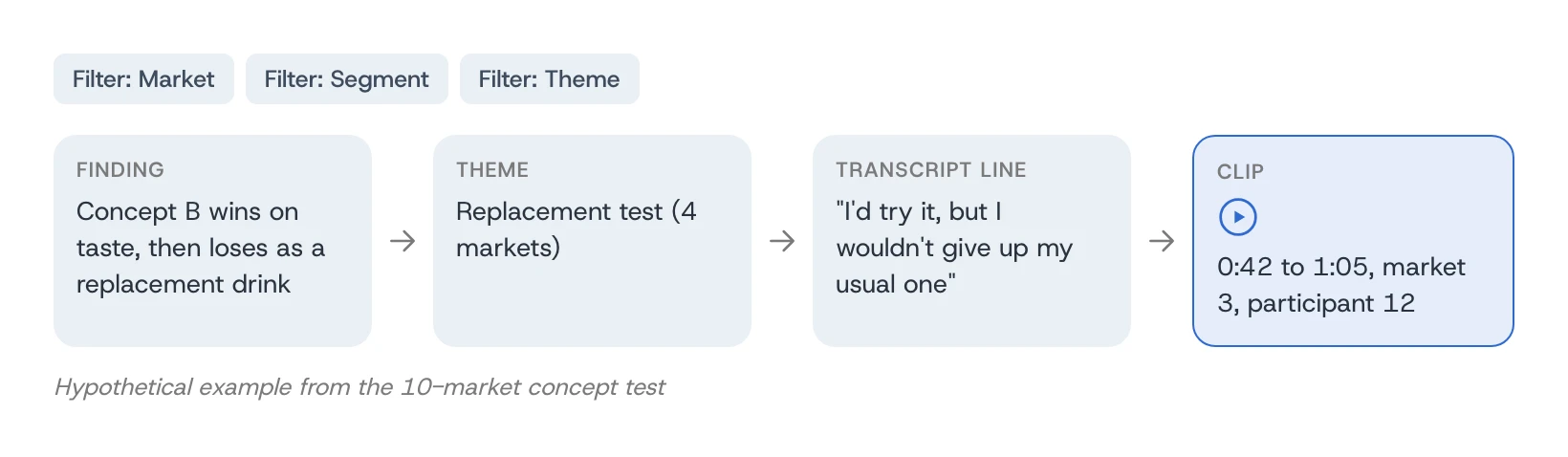
Read figure details
- Finding
- Concept B wins on taste, then loses as a replacement drink
- Theme
- Replacement test (4 markets)
- Transcript line
- "I'd try it, but I wouldn't give up my usual one"
- Clip
- 0:42 to 1:05, market 3, participant 12
7. The deck and the dashboard
The finished output usually comes in two forms. The deck tells the story for leadership, with video proof on the slides that matter. The dashboard serves the team after the meeting, where people filter findings by market or segment and play the clips directly.
The launch review gets the deck, and the regional teams get the dashboard to check their own markets. Both open to the same clips, so nobody argues from a different version of the evidence.
How to evaluate an AI-moderated research provider
Weigh providers on the evidence in their written answers and a sample interview. Ask each one the same questions and set the answers side by side. Here are six of them, each with what a good answer includes and the warning sign to watch for.
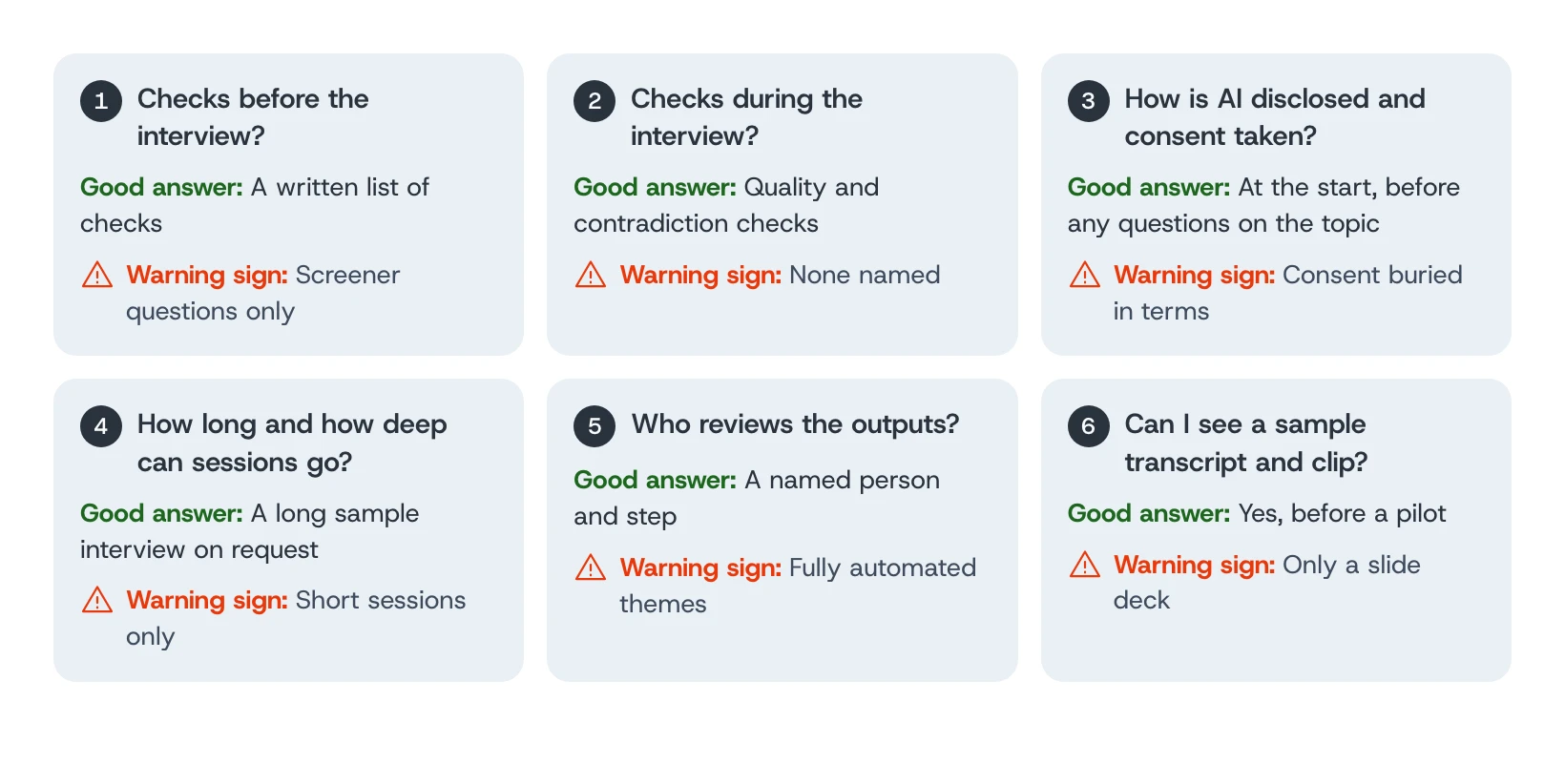
Read figure details
- 1Checks before the interview?
- Good answer: A written list of checks Warning sign: Screener questions only
- 2Checks during the interview?
- Good answer: Quality and contradiction checks Warning sign: None named
- 3How is AI disclosed and consent taken?
- Good answer: At the start, before any questions on the topic Warning sign: Consent buried in terms
- 4How long and how deep can sessions go?
- Good answer: A long sample interview on request Warning sign: Short sessions only
- 5Who reviews the outputs?
- Good answer: A named person and step Warning sign: Fully automated themes
- 6Can I see a sample transcript and clip?
- Good answer: Yes, before a pilot Warning sign: Only a slide deck
1. Participant quality and AI disclosure
A smooth AI moderator still produces useless data from the wrong people, so participant quality comes first. Ask the provider to put the two layers from the recruitment stage in writing, and to say who reviews a session that fails a check.
Disclosure belongs in the same conversation. Ask how participants learn that an AI is running the interview, and when consent is taken. The answer should be at the start, before any questions on the topic.
How to test it: Ask whether a session that fails a check during the interview still counts toward the delivered study. The right answer is that it comes out of the sample.
2. Interview depth and session length
Some analysts see AI interviews as best for quick, directional reads. A Forrester analyst post from August 2026 says they suit short conversations, typically under 30 minutes.3 Session length varies by provider, so treat it as a question to ask.
Ask for a long sample interview and read the second half closely. If the late probes still draw on early answers, the moderator is holding context but once they slide into stock prompts that could follow any answer, the session has outrun it.
3. How output quality is checked
"AI analysis" covers a wide range. At one end, an automated pipeline turns transcripts into themes with no person involved. At the other, a managed service has researchers adjust the themes and choose the clips before anything ships.
So the useful question concerns quality assurance rather than technology. Ask who checks the themes before delivery and what they check them against; a provider with a clear answer can name the person and the step.
How Echovane runs an AI-moderated study
Echovane takes a managed approach. You bring the business question, and Echovane hands back a finished study as a done-for-you, white-glove service. The parts below show one study from start to finish, followed by what sits behind it.
1. The 10-market concept test as Echovane would run it
Here is how the hypothetical concept test could run with Echovane, from question to insight. You lead the first step and the review, and Echovane handles the rest.
- The question (you): Which of three drink concepts earns a place in the launch plan, and why?
- Guide and participants (Echovane): Echovane's researchers and AI agents write the guide and screener, then recruit and verify participants across the 10 markets.
- The first market (Echovane): Echovane's AI moderator runs it in natural voice-to-voice conversation, with no clicking between questions.
- The review (you): You watch the first batch, the guide gains a question, and the other nine markets run. Live steering is work in progress, so changes land between batches.
- The insight (Echovane): A deck with video proof plus dashboard access. The lead theme is that concept B loses once participants picture it replacing their usual drink.
A dedicated researcher and human QC sit on every study, and every finding is traced to the clip behind it. Separately, Echovane goes from brief to report in 2 to 3 days for general population studies.
“Echovane reached exactly the right participants and let us test, learn and iterate continuously across multiple audiences, countries, and product variants all within a single study that would be impossible to execute at speed and scale.”
Adam D’arcy, Chief Product Officer at Trustly

2. Recruitment reach across markets and niche audiences
Echovane works through panel recruitment and specialized fieldwork, reaching 30M+ participants across 90+ countries, with interviews in 65+ languages. Each market's participants in the concept test speak in their own language, and the team compares markets in one set of findings.
Niche audiences are where recruitment usually breaks. Echovane recruits niche B2B and B2C audiences below 0.1% incidence (the share of the population that meets the study's criteria).
Every participant passes the two verification layers described earlier, as part of the model and not as an add-on. Echovane interviews real, verified people, with consent always taken.
3. How a managed study differs from a self-serve tool
A self-serve tool gives your team a platform, and your team runs the study. Echovane delivers a finished study.
Inside each interview, Echovane's AI moderator runs 0 to 30 minute short interviews and 30 to 90+ minute deep interviews. Long sessions keep their quality and context, and adaptive probing is customizable in the dashboard without code.
Contradiction checking and recall of video or audio from earlier moments sit alongside the probing. Echovane also offers analysis of tone of voice and facial expression in AI moderation, plus eye tracking with no extra hardware needed. It is the only platform with AI-moderated eye tracking.
Research Brain also keeps past studies searchable with clips as proof, so each new study starts from what earlier ones found.
Put AI moderation to the test on your next launch decision
The beverage team's real deadline is the launch review, and the research has to serve that date. The quickest way to know whether AI moderation can carry the decision is to run part of it now on the concepts and markets that matter most.
- Pick the decision: Choose one concept or pack call tied to a real date, like the launch review.
- Pilot where it counts: Run 50 to 200 interviews in the one or two markets that weigh most on that call.
- Apply the stakeholder test: Check whether a brand lead could defend the recommendation from the clips alone, then judge theme depth and how the dashboard works for your team.
If the pilot holds up, the remaining markets follow with the same guide and the review already built in. The team then walks into the launch review with evidence in participants' own words. For where the method sits among other consumer research methods, see the guide to AI in consumer research.
Test it on a decision you already have
Bring one concept and its deadline, and book a demo to scope a pilot with Echovane in the markets that matter most.
Frequently asked questions
Do participants need special equipment for an AI-moderated interview?
Usually not. Echovane's interviews run as a natural voice-to-voice conversation with no clicking between questions. Its eye tracking needs no extra hardware, so participants join from a device they already use.
How long can an AI-moderated interview run?
It depends on the provider and the guide. Echovane runs 0 to 30 minute short interviews and 30 to 90+ minute deep interviews, with its long sessions keeping their quality and context throughout.
Are AI-moderated interviews as reliable as human-moderated ones?
On guided topics, they come close. At equal budget, one preregistered study found AI-moderated interviews recovered more customer needs than the alternatives4, though human moderators still drew out more unprompted detail.
Can an AI-moderated study include quantitative questions?
Yes. Echovane runs qualitative and quantitative studies, including large-scale quant. A study can pair participants' ratings with the reasons behind them, so depth and measurement sit in one research plan.
Sources
- Semra Guven, Tobias Gårdhus, Andreas Bjerre-Nielsen, Anna Rogers and Hjalmar Bang Carlsen, "Can AI interview? Comparing AI-led to Human-led Chat Interviews," arXiv 2610.23149, October 16, 2026. Randomized experiment with 41 university students interviewed by text chat. arxiv.org.
- Jeff Sauro, Lucas Plabst, Eva Sundberg and Jim Lewis, "Do AI and Human Moderators Uncover the Same Facts?" MeasuringU, November 17, 2026. Randomized study of 20 participants using the same discussion guide. measuringu.com.
- Senem Guler Biyikli, "AI-Moderated Interviews Expand How Teams Conduct Customer Research," Forrester blog, August 10, 2026. forrester.com.
- Yuting Deng, Jingxuan Liu, Olivier Toubia and Naman Jain, "AI-Moderated Interviews for Market Research and Digital Twins Calibration," arXiv 2609.29143, version 2, November 2, 2026. A preregistered study with 139 AI-moderated, 154 static and 24 human-moderated interviews. arxiv.org.