

An AI moderator runs your research interviews. You still own the study.
An AI moderator can carry the interview itself. This guide shows where it takes over, and which decisions stay with your team.

Key takeaways
- An AI moderator runs the interview session itself, asking your guide's questions and writing probes from each participant's own words.
- Every stage around the session stays shared or with you, including guide sign-off and the final interpretation.
- Designs and concepts can run inside the interview, with exposure time and order set by you beforehand.
- Changes to a running study usually wait for a review between phases, so plan that review time from the first day.
- A vendor worth a pilot shows you a written task split and its participant checks, and states its limits up front.
- Echovane runs this split as a done-for-you service, with its AI moderator running interviews and a dedicated researcher working with you on the guide and findings.
An AI moderator in qualitative research interviews runs each conversation for you, from the first question to the last follow-up. It works from your discussion guide, probing on what each participant says and showing your stimulus on cue, across every session.
Because those sessions run in parallel, a tight deadline looks different. Take a hypothetical shopper insights team at a household-care brand, testing two pack redesigns in four markets with a retailer range review just five weeks out. An agency timeline would land too late, so then how much of the study can an AI moderator carry?
The short answer is the interview session itself, always with a real, verified participant on the other side. Everything around it, from the brief to the retailer story, stays shared or with you. In this guide, you follow the pack team's study stage by stage, seeing where the AI moderator takes over and where you step back in.
It also covers what to ask a vendor before a first pilot as well as what a managed study looks like in practice.
What "AI moderator" means in a research interview
In research, an AI moderator is an AI system that conducts interviews on its own, guided by your discussion guide (the planned topics and questions). It adapts its follow-up probes to each answer, so no person has to run the session.
The term covers three different jobs, and search results mix them freely. Only the first one is about research, and the job title with the same name is a separate topic.
- Research interviews: AI that runs one-to-one interviews, and on some research platforms, small group sessions. It asks the guide's questions and adapts each probe, then summarizes what it heard without the scheduling bottleneck of a booked moderator.
- Classroom and forum discussion: AI that guides debates among students or forum members. It tracks who has spoken and flags conflict to help people compare viewpoints.
- Content and community moderation: AI that flags spam and policy breaches at speed across chats and comment sections on large platforms.
From here on, the guide stays with the first meaning and one practical question. When an AI moderator runs your interviews, which parts of the work does it take, and which stay with you? The two sections below set it against the tools you already know, then name what makes it a research tool.
1. How it differs from a scripted survey or a human moderator
A scripted survey moves along fixed branches. An unexpected answer will still route straight to the next question. A skilled human moderator, on the other hand, adapts well, though one person can run only one session at a time.
Between the two sits the AI moderator. It adapts each follow-up to what the participant said, and it keeps the same interview structure across every session in every market. When a shopper says the new packaging "looks cheaper," the next question asks what on the pack gave that impression.
The evidence so far is encouraging, with a few caveats. A preregistered study of 317 participants, revised in November 2026, found AI-moderated interviews matched human ones on depth and covered more themes.1 Although participant engagement leaned a bit more toward a human moderator. That’s why the table below compares how each handles the work instead of picking which one wins.
| Area | AI moderator | Human moderator |
|---|---|---|
| Who writes the guide | You, often with AI drafting help | You, or an agency moderator |
| Depth of probing | Follows each answer to the depth you set per question | Follows instinct and rapport, and varies by moderator |
| Sessions at once | Many in parallel | One at a time |
| Pacing | Holds the time set in the guide for every session | Adjusts in the moment |
| Stimulus handling | Timed exposure and rotated order, run by the same rules for every participant | Shown by hand, with some variation |
| Review of findings | You review recordings and AI-coded themes | Moderator debrief, then your review |
A common pattern pairs the two. The AI moderator covers breadth across markets, and a human moderator follows up with the handful of participants whose answers call for a live conversation.
2. Three things an AI moderator must do to qualify as a research tool
A chatbot that asks questions in order is a different tool from a research moderator. Three behaviors separate them, and together they explain why an AI moderator can carry a qualitative interview at all.
| Capability | Why it matters |
|---|---|
| Probes built from the participant's own words | Generic follow-ups produce generic answers |
| Contradiction checks | A shopper who says price drives choice, then picks the pricier pack, needs a follow-up |
| Quality checks during the interview | Probing depth means little if the answers come from a disengaged or unqualified person |
A tool missing any one of the three is a question-delivery system, which is a different purchase entirely. Now, take a look at where the AI moderator sits in a real study.
A step-by-step map of what the AI moderator runs
Only one stage belongs completely to the AI moderator, the live session, where it controls the conversation and the stimulus. The others carry a decision that stays with you or is shared. A typical AI-moderated research study runs in six stages:
- Guide design
- Screener and recruitment
- Live session
- Phased review
- Analysis
- Delivery and interpretation
Mark the stages your team could hand over as you read. The sections below cover stages 1 to 3, and stages 4 to 6, with participant checks, sit under what stays with the researcher.
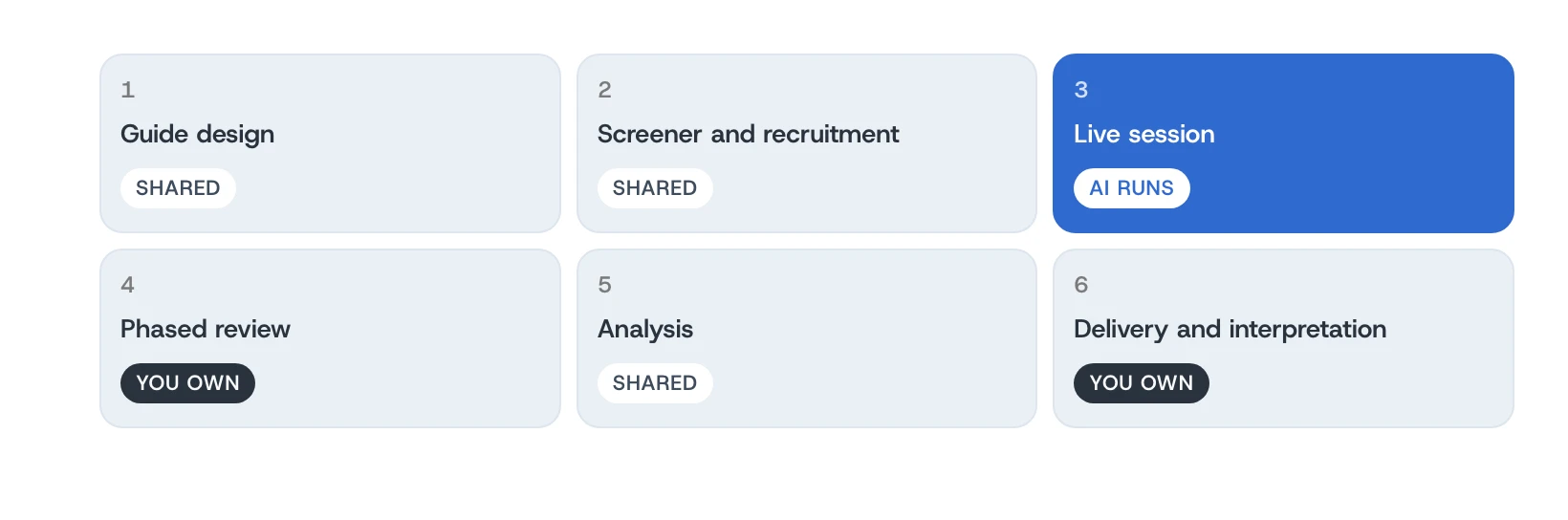
Read figure details
- 1
- Guide design shared
- 2
- Screener and recruitment shared
- 3
- Live session AI runs
- 4
- Phased review you own
- 5
- Analysis shared
- 6
- Delivery and interpretation you own
1. Guide design and screener, and who writes the questions
Your approved guide is what the AI moderator runs. The first draft can come from AI or a research partner, but it starts from your business question, and you sign it off before fieldwork.
The guide sets the ceiling. A 20-participant MeasuringU experiment from November 2026 found AI sessions trailed human ones by about 8 points on themes the guide covered.2 On the two themes it left out, AI sessions trailed by 30 and 73 points.
The screener (the short questionnaire that decides who qualifies) deserves the same care. A loose screener recruits the wrong shoppers, and no amount of skilled probing rescues a study full of them.
For the pack study, the screener might ask for people who bought the category at the target retailer last month. It might also ask that they chose between two named brands on that trip. Write criteria as behavior you can check, so the AI moderator spends its probes on the right people.
2. The live interview session (questions, probes, timing and stimulus)
Once the participant joins, the AI moderator controls the conversation and the stimulus. You set the rules for both beforehand, and it applies them the same way in every session. The figure below shows the five tasks it runs in the session, each paired with the rule you set before fieldwork.
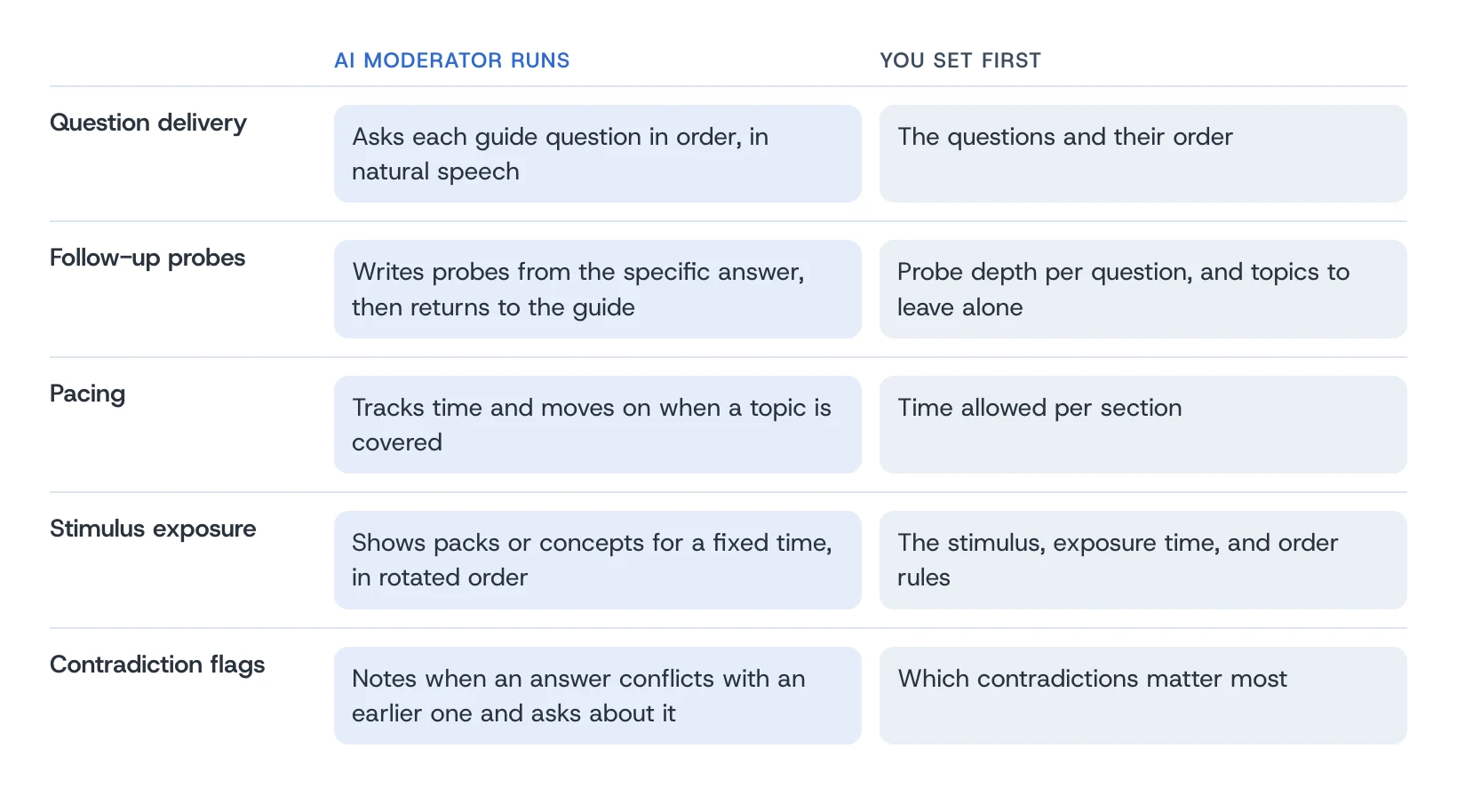
Read figure details
- Question delivery
- AI moderator: asks each guide question in order, in natural speech. You decide: the questions and their order.
- Follow-up probes
- AI moderator: writes probes from the specific answer, then returns to the guide. You decide: probe depth per question and topics to leave alone.
- Pacing
- AI moderator: tracks time and moves on when a topic is covered. You decide: time allowed per section.
- Stimulus exposure
- AI moderator: shows packs or concepts for a fixed time, in rotated order. You decide: the stimulus, exposure time, and order rules.
- Contradiction flags
- AI moderator: notes when an answer conflicts with an earlier one and asks about it. You decide: which contradictions matter most.
Pacing depends on the guide setting probe depth per question, and it matters most in long sessions. In AnswerLab's dry runs in November 2026, interviews planned for 20 to 25 minutes ran 35 to 44 because the moderator kept probing.3
Stimulus is where shopper studies earn their keep. In a monadic test (each participant sees one version), half the sample sees pack A and half sees pack B. A sequential test shows each participant both, and the AI moderator rotates the order so neither pack always goes first.
Before fieldwork starts, you decide the exposure time and the questions that follow each reveal. Your input on the live session happens there, and again at the review between phases.
3. Participant experience, and when and where the interview happens
Participants take the interview on their own schedule, so sessions in several time zones run in parallel. They join on their own device, by voice or video.
A remote shop-along has the participant share their phone screen while browsing a grocery app. The AI moderator asks about each product they tap on or scroll past, and the same works in-store, filmed on the phone.
Attention on pack can be measured from home as well. Webcam eye tracking needs no extra hardware, so a participant can look at a digital shelf while the study records where their eyes land first.
User experience teams use the same setup for prototypes. A participant shares their screen while trying a new checkout flow, and the AI moderator asks what they expected at each step.
What stays with the researcher and the human review points
Human oversight matters most when a decision carries real stakes, and a retailer range review is one of those moments. Whatever the AI moderator runs, these jobs stay with you.
- The business question: What the range review needs to settle.
- Guide and screener sign-off: The final say on whom you hear from and what you ask.
- Review between phases: Watching early recordings before the rest of the interviews run.
- Interpretation: The story you take to stakeholders and the retailer.
“Say a team plans taste expectations first and ingredient questions last. When our researcher and the client review the opening clips of a phased study, participants keep raising an unfamiliar ingredient before anything else. We rarely spot that sequence problem on paper. Between phases, we move a short ingredient question to the front of the guide, and the answers afterward get clearer.”
Smriti Gupta, CEO, Echovane
4. Phased review and how mid-study adjustment works without live steering
Changes to a study in fieldwork usually wait, so course correction happens between phases. You watch the early recordings and adjust the guide, and the next phase runs with the change.
In the hypothetical pack study, the first phase is 20 interviews per market. Reviewing them, the team sees shoppers in two markets reading the refill claim on pack B as a price promotion. A survey score would have shown a preference for pack B and left the reason hidden.
The team rewords the question that follows the pack reveal and adds one probe on what "refill" means to shoppers. The next phase runs with both changes, and the final read separates the claim from the price story.
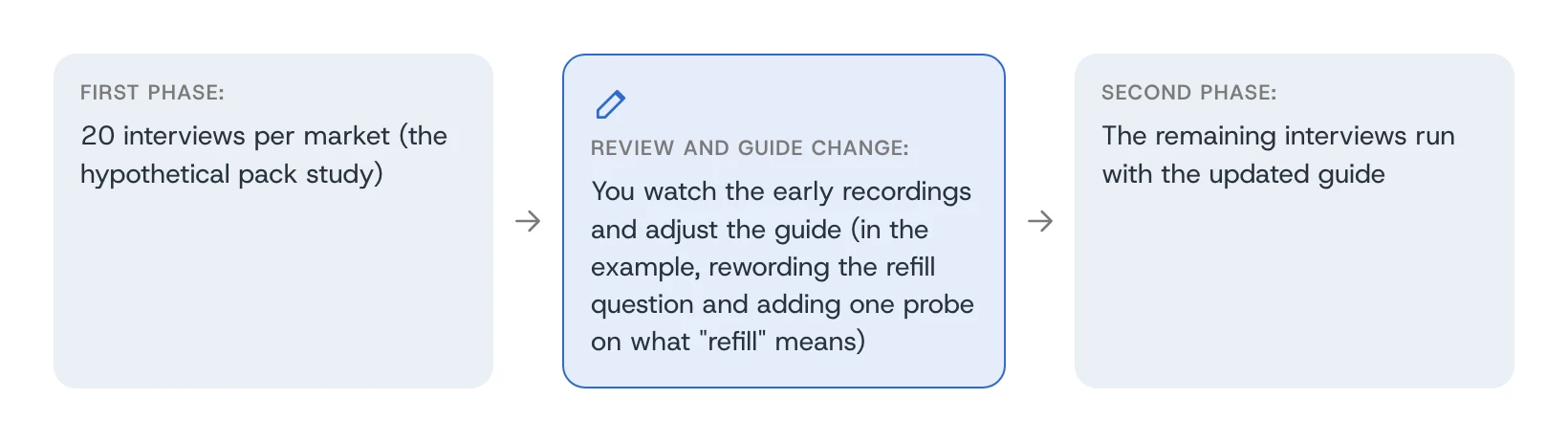
Read figure details
- First phase:
- 20 interviews per market (the hypothetical pack study)
- Review and guide change:
- You watch the early recordings and adjust the guide (in the example, rewording the refill question and adding one probe on what "refill" means)
- Second phase:
- The remaining interviews run with the updated guide
5. Analysis and interpretation (what the AI surfaces versus what it cannot decide)
Analysis starts with a mechanical layer the AI produces. You get transcripts and thematic summaries, each theme backed by cited clips, which cuts the time spent coding by hand.
Your role shifts to judgment here. Decide which themes matter for the range review and which findings challenge the brand team's assumptions, then shape the recommendation the buyer will act on.
Handing over interpretation is the costly mistake. A theme sitting fifth in the AI summary may carry the commercial point, such as a refill message read as a discount. It takes someone who knows the business to see it.
6. Participant quality and verification to look for
Quality starts with the screener and continues with verification at two points, and you need to ask any vendor to show you both in writing. Layered checks make fraud much harder, though none rule it out entirely.
- Before the interview: Screener authenticity, IP address and location, identity and phone verification, duplicate accounts, VPN and proxy use, a live human voice, and human-written responses.
- During the interview: Response quality, engagement, contradictions, and genuine category experience.
Strengths and limits to plan around
Every AI moderator brings clear strengths and a few predictable limits. Three strengths stand out.
- Parallel sessions: Many interviews run at once, across markets and time zones.
- Consistency: Every participant hears the same core questions in the same way.
- Any-hour fieldwork: Participants join when it suits them, day or night.
Three limits come with them, and a specific review point catches each one. Plan the review time for all three before fieldwork starts.
- Misread confusion: It can take a confused answer as a real one. Phased review of early recordings catches it.
- Subtle tone: It can miss sarcasm or a dry aside. You catch it when you watch the flagged clips.
- Unusual cases: An edge case outside the guide can get a weak follow-up. Your interpretation catches it before findings go out.
Many AI moderators narrow these limits too. Some analyze tone of voice and facial expression, so you read how something was said as well as what. Others check each answer against earlier ones, or bring back a moment from earlier in the session to probe deeper. The next section shows how to check which of these a vendor offers.
How to evaluate an AI moderator before you commit
Judge a vendor on what it can show you, in writing and in a test interview. Put the same questions to every provider of an AI-moderated user interviews tool or service, and compare the answers side by side. If procurement wants a wider governance checklist, the research industry body ESOMAR publishes 20 Questions to Help Buyers of AI-Based Services.4
1. Test whether the division of tasks is documented
Ask for a written task split that shows what the AI runs and where people review. A vendor that can document the split, including when phased review happens, is selling something you can plan around.
| Question to ask | A clear answer looks like | Warning sign |
|---|---|---|
| Which tasks does the AI moderator run? | A written list by study stage | "It handles everything" |
| Where do people review the work? | Named review points with owners | Review "as needed" |
| How is review between phases scheduled? | Dates in the project plan | A single phase with no review |
| How are participants verified? | Checks before and during the interview | Screener questions only |
| Who signs off the guide? | You, after a named draft owner | The AI generates it unreviewed |
| How deep do the probes go? | Follow-ups that quote the participant's own words | Generic prompts such as "tell me more" |
One way to test the tool is to sit through one interview in the participant's seat, with no script prepared. Give a lazy answer to two consecutive questions and see whether the moderator lets them pass.
2. Test disclosure and stated limits
Ask what the vendor's AI moderator is still unable to do, and note whether the answer comes freely. A vendor that maps its limits up front is easier to plan around.
Check disclosure as well. Participants should hear that they are speaking with an AI moderator and consent before the first research question. The same AnswerLab dry runs caught an interview carrying on after a declined consent.3
To confirm this, ask for a test link and decline consent at the start. The session should end there, with no research question asked.
How Echovane's AI moderator works inside a managed study
Echovane is an example of a managed approach to AI-moderated interviews. It works as a done-for-you, white-glove research service, where you state the business question and the company delivers the finished study.
Echovane's team works with you on the guide and screener, and its AI moderator runs the interviews. That differs from self-serve software, which your own team runs.
1. One session from the pack study, step by step
Here is how one interview from the hypothetical pack study could run with Echovane's AI moderator, from brief to insight. Your team leads the brief and the review, then acts on the insight.
- The brief: Your team asks which pack design makes the refill claim clearer at shelf and signs off a 30-minute guide with probe depth set for each question.
- The session: A verified shopper joins by video from home. Echovane's AI moderator asks about their last shop, then shows pack A and pack B in rotated order as eye tracking records their first look.
- The probe: The shopper says pack B "looks like a deal." The moderator brings back the video moment they first saw the refill claim and asks what gave that impression.
- The contradiction check: Earlier, the shopper said price never decides a cleaning product. The moderator notes the conflict and asks what changed.
- Your review: On the dashboard, you watch flagged clips from the first phase, alongside the analysis of tone of voice and facial expression. You then reword the refill question for the next phase.
- The insight: The final deck traces the finding to the clips behind it. Shoppers read "refill" as a promotion, so pack B needs the claim reworded before the range review.
2. What Echovane's AI moderator does, and what comes with every study
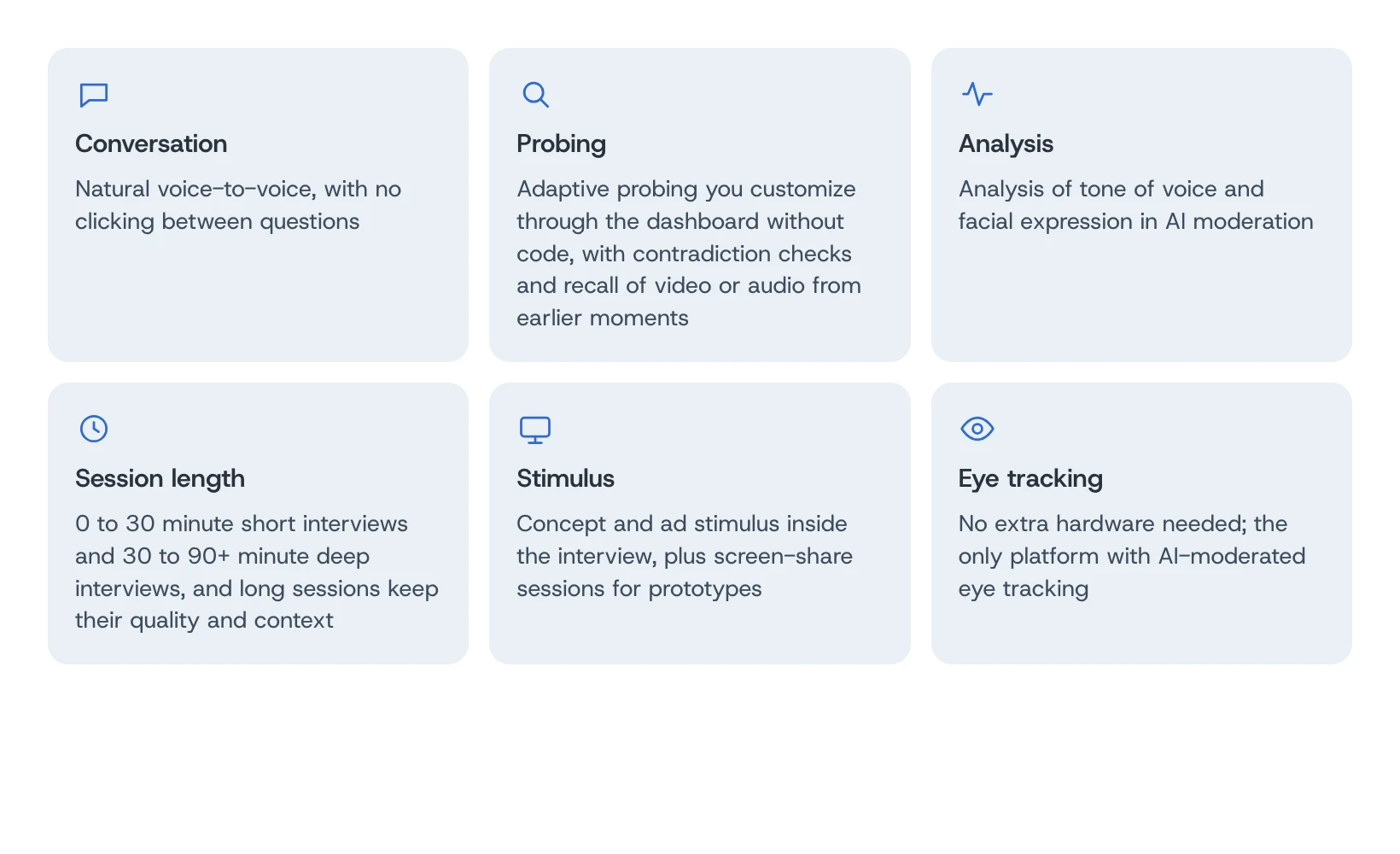
The session above draws on a fixed set of capabilities, shown in the figure below. They include eye tracking with no extra hardware needed, and Echovane is the only platform with AI-moderated eye tracking.
Read figure details
- Conversation
- Natural voice-to-voice, with no clicking between questions
- Probing
- Adaptive probing you customize through the dashboard without code, with contradiction checks and recall of video or audio from earlier moments
- Analysis
- Analysis of tone of voice and facial expression in AI moderation
- Session length
- 0 to 30 minute short interviews and 30 to 90+ minute deep interviews, and long sessions keep their quality and context
- Stimulus
- Concept and ad stimulus inside the interview, plus screen-share sessions for prototypes
- Eye tracking
- No extra hardware needed; the only platform with AI-moderated eye tracking
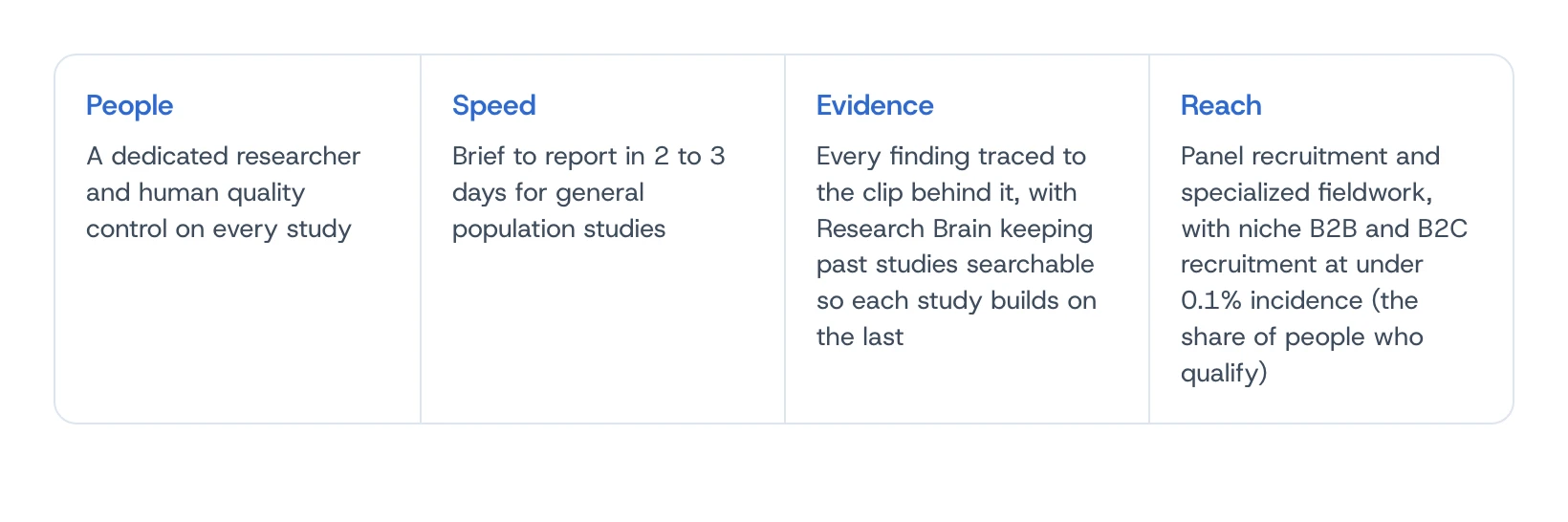
Every participant passes the two layers of verification. Consent is always taken, and every participant is a real, verified person, on camera in video sessions. Around the interview, every study comes with a dedicated researcher and human quality control.
Read figure details
- People
- A dedicated researcher and human quality control on every study
- Speed
- Brief to report in 2 to 3 days for general population studies
- Evidence
- Every finding traced to the clip behind it, with Research Brain keeping past studies searchable so each study builds on the last
- Reach
- Panel recruitment and specialized fieldwork, with niche B2B and B2C recruitment at under 0.1% incidence (the share of people who qualify)
“Echovane has made complex, multi-market studies feel simple. They find the right hard-to-reach participants, handle the nuances across markets and languages, and deliver actionable insights with remarkable speed and consistency.”
Zee Alcasid, Consumer Science and Product Experience Lead, Haleon


Where the AI moderator stops, and your judgment starts
The pack team now has its six-stage map and the jobs it keeps, plus a set of questions for any vendor. Take one upcoming study with a fixed date, such as a range review, and map it against the six stages. Mark the two or three stages where your current process loses the most time, then check whether an AI moderator would take them on.
That is the real decision behind an AI moderator. It can carry every session to the same standard in every market, while the brief and the meaning of the findings stay with you. Teams that draw that line early get the speed without giving up the study.
Test the split on your own study
Echovane’s AI moderator runs the sessions, and you keep the question and the answer. Bring one study with a fixed deadline and book a demo to scope the pilot study around it.
Frequently asked questions
Can an AI moderator interview people in their own language?
Yes, Echovane interviews real, verified people in 65+ languages across 90+ countries. A multi-market study runs in each participant's own language, and the findings come back together for direct comparison.
Can AI-moderated interviews replace focus groups?
They replace some of them. One-to-one AI-moderated interviews give depth at scale, while a focus group studies how people sway each other. Choose based on whether that group effect is part of your question.
Is AI moderation suitable for sensitive topics?
It depends on the topic and the duty of care involved. Clear consent and human review of recordings matter more than the moderator type, and participants need an easy way to stop at any point.
How many interviews should a first AI-moderated study include?
A typical Echovane pilot is one paid study of 50 to 200 interviews in one or two markets. You can book a demo to scope the pilot study around your own deadline.
Sources
- Yuting Deng, Jingxuan Liu, Olivier Toubia and Naman Jain, "AI-Moderated Interviews for Market Research and Digital Twins Calibration," arXiv 2609.29143, version 2, November 2, 2026. A preregistered study with 139 AI-moderated, 154 static and 24 human-moderated interviews. arxiv.org.
- Jeff Sauro, Eva Sundberg, Lucas Plabst and Jim Lewis, "Do AI Moderators Uncover as Much as Human Moderators?" MeasuringU, November 3, 2026. Randomized study of 20 participants using the same discussion guide; figures are percentage-point differences in how often a theme appeared. measuringu.com.
- Leah Namdar-Cohen, "The New Craft of AI Moderation," AnswerLab, November 9, 2026. Pre-field dry runs with test inputs, not real participants. answerlab.com.
- ESOMAR, "20 Questions to Help Buyers of AI-Based Services." esomar.org.