


There is a sentence I have heard in almost every debrief I have ever attended. A participant says something like "yeah, it's fine" or "I don't really have a preference" or "my routine is pretty normal." And the moderator moves on, because the words gave them nothing to work with.
But anyone who has ever watched a person actually use a product in their home knows that what people say and what people do are often two completely different stories. Not because they are being dishonest. Because most of the interesting stuff happens below the level of conscious awareness. The awkward grip on a bottle they have adapted to over months. The product they reach past every morning without realising they have made a choice. The half-second hesitation before selecting a brand that reveals the decision is less automatic than they think.
For decades, the only way to access this layer of insight was ethnographic research. Send a trained observer into someone's home, watch them live their life, and notice the things they cannot articulate. It works beautifully. It is also expensive, slow, limited to small sample sizes, and impossible to scale.
That is changing. Multimodal AI, systems that process video, audio, facial expressions, and environmental context simultaneously, is creating a new category of research that captures what transcripts miss. Not to replace the conversation, but to see everything happening around it.
This article is about what multimodal means in a research context, why it matters so much for the kinds of decisions consumer brands face, and where the technology is genuinely useful today.
What Multimodal Actually Means in Research
The term gets used loosely, so let me be specific.
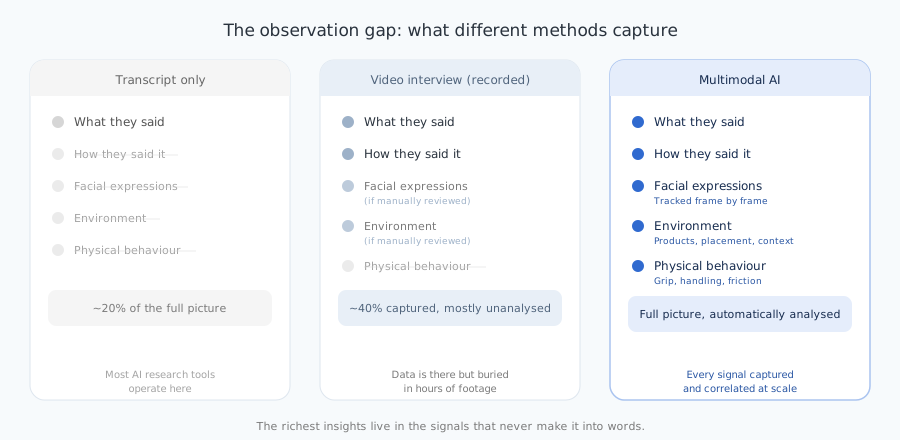
Most AI research tools today are text-based. They process what participants say, either as typed responses or as speech-to-text transcription. The analysis happens on the words. That is a significant step forward from manual transcript coding, but it is still limited to a single channel of information.
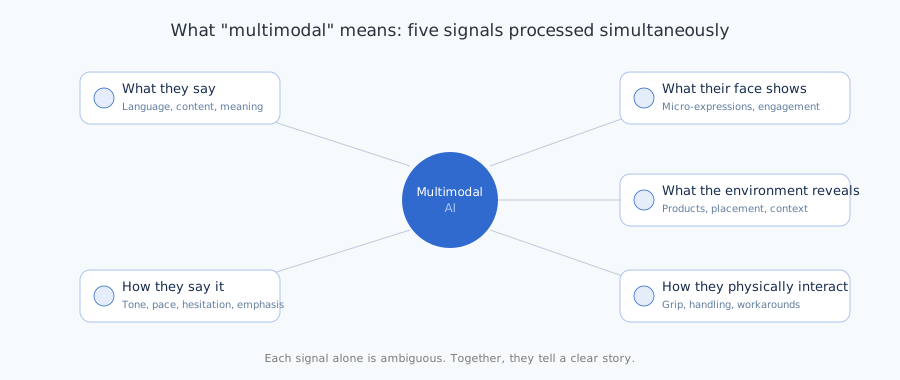
A multimodal system processes multiple types of information at the same time: what the participant says (speech and language), how they say it (vocal tone, pace, hesitation, emphasis), what their face communicates (micro-expressions, emotional shifts, engagement levels), and what their environment reveals (product placement, usage context, physical behaviour with objects).
The important word is simultaneously. It is not about recording video and then analysing the transcript separately. It is about understanding all of these signals together, in context, as they happen. A participant says "this packaging is fine" while their face shows a brief frown and their hand is using a spoon to pry open a lid. Each signal alone is ambiguous. Together, they tell a clear story.
This is what human ethnographers do naturally. They watch and listen at the same time, and their training helps them notice the moments where the signals diverge or where the environment reveals something the participant has not mentioned. Multimodal AI does the same thing, at scale, across hundreds of sessions, with consistent attention to every moment in every conversation.
Why This Matters So Much for Consumer Brands
Consumer research has a structural problem that most people in the industry acknowledge but few methodologies have been able to solve.
The problem is this: the most important insights about how people interact with products live in behaviour, not in language. How someone opens a package. Where they store a product relative to competitors. How long they spend looking at a shelf before deciding. Whether they reach for the same item automatically or pause to consider alternatives. The micro-expression that flashes across their face when they taste something, smell something, or try to use something that does not quite work the way they expected.
None of this shows up in a transcript. It does not matter how skilled the moderator is or how well the discussion guide is written. If the methodology only captures words, it is structurally blind to the richest layer of consumer behaviour.
This is not a theoretical concern. It affects real decisions every day. A packaging team redesigns a closure mechanism based on interview feedback that says consumers find the current design "acceptable." Meanwhile, observational data would have shown that most users have developed a workaround to open it, that the workaround is so ingrained they no longer register it as a problem, and that a competitor's closure design gets opened faster with less visible effort. That is the difference between "acceptable" and "opportunity."
Four Things Multimodal AI Observes That Transcripts Miss
Let me get concrete about what this looks like in practice.
1. Facial micro-expressions during product interaction
When a participant is shown a new concept, watches an ad, or uses a product for the first time, their face tells a story in real time. A flash of confusion that lasts less than a second. A slight nose wrinkle indicating mild displeasure. Raised eyebrows signalling genuine surprise. These expressions are involuntary, fast, and often completely absent from verbal feedback.
Multimodal AI tracks these expressions frame by frame and correlates them with the specific moment in the experience that triggered them. In ad testing, this means understanding exactly which scene caused engagement to drop. In concept testing, it means seeing which claim landed and which one created confusion, even when the participant's verbal feedback was uniformly positive.
The academic research on automated facial expression analysis has matured significantly. The multimodal approach that combines facial data with vocal and textual signals is now far more reliable than any single-signal system alone. The key advance in the last two years has been systems that triangulate across multiple signals rather than relying on facial coding in isolation.
2. Environmental context and product placement
When a participant shows their home environment on camera, the background is not just background. It is data.
Where do they store the product? Is it front and centre on the counter, or pushed to the back of a cabinet behind other items? Are there competitor products visible? Are there products from adjacent categories that suggest unmet needs or usage occasions the brand has not considered?
A multimodal system observes the environment continuously. It notices the unopened competitor product sitting on the shelf. It sees that the "everyday" product is stored in a hard-to-reach location, which contradicts the participant's claim that they use it daily. It identifies other products in the frame that suggest lifestyle context the participant would never think to describe.
This is the kind of observation that an ethnographer captures in field notes. The difference is that AI can do it across hundreds of sessions, consistently, and flag the patterns that emerge.
3. Physical interaction with products and packaging
How someone handles a product reveals things that language cannot express. The grip they use, the force required, the hand they choose, the angle they approach from, the workarounds they have developed for packaging that does not work quite right.
For innovation teams and packaging designers, this is some of the most actionable data in all of consumer research. A participant who says "the packaging is fine" while visibly struggling with a closure mechanism is giving you two pieces of information. The verbal data says no problem. The physical data says redesign opportunity.
Multimodal AI captures these physical interactions on video and identifies moments of friction, hesitation, and adaptation. It does not require the participant to self-report the struggle, which they usually will not do because they have normalised it. The observation stands on its own.
4. Vocal signals beyond words
The same sentence can mean completely different things depending on how it is delivered. "I would probably buy this" spoken with rising intonation and a slight pause is very different from the same words spoken with flat conviction. "It's interesting" delivered with genuine enthusiasm signals something entirely different from "it's interesting" spoken with the slight downward tone that usually means "I am being polite."
Multimodal AI analyses prosody, pace, pause patterns, and tonal shifts alongside the transcript. When a participant's vocal delivery contradicts or adds nuance to their words, the system flags it. This is particularly valuable in concept evaluation and brand perception research, where participants often deliver socially acceptable verbal feedback while their vocal patterns reveal genuine engagement or lack of it.
Where This Changes Research in Practice
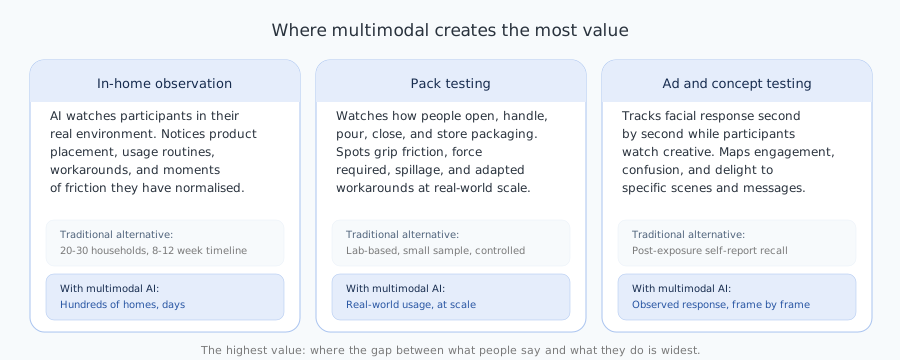
The use cases where multimodal capability creates the most value are the ones where the gap between what people say and what they do is widest. Three stand out.
In-home observation and ethnographic studies
Traditional in-home research means sending a researcher to the participant's home, spending hours observing their routines, and coming back with detailed notes and video footage. The quality of insight is extraordinary. The cost, the logistics, and the geographic constraint mean that most brands can only do this with a handful of households.
Multimodal AI enables in-home observation at scale. The participant shares their real environment via camera, goes about their routine, and the AI watches everything: the products on the counter, the sequence of steps, the moments of friction, the things that get skipped, the items that get reached for without thought. It captures the same kind of observational richness that an in-person ethnographer would, across dozens or hundreds of households simultaneously.
The participant does not need to describe their routine. They just do it. The AI observes and identifies the patterns, the workarounds, and the unspoken preferences that no interview question could elicit.
Pack testing and packaging research
Package design research has historically relied on two approaches: asking people what they think of a package (verbal feedback, which is heavily influenced by what the participant believes is the "right" answer) and controlled lab environments where researchers watch people interact with packaging (accurate but expensive and small-scale).
Multimodal AI adds a third option: watching people interact with actual packaging in their real environment. How do they open it? Do they read the label? Which hand do they use? How long does it take? Do they put it down and pick it up differently than they did the first time? Is there a visible moment of satisfaction or frustration?
This data is directly actionable for packaging engineers and designers. It does not replace lab-based testing for structural validation, but it provides a layer of real-world usage insight that lab environments cannot replicate.
Ad and concept testing
The standard approach to ad testing asks participants to watch creative and then describe what they thought and felt. The problem is well understood: people are not very good at accurately reporting their emotional responses to media. They rationalise. They construct a narrative. They tell you what they think you want to hear.
Multimodal AI watches the participant's face while they watch the ad. It tracks engagement, confusion, surprise, delight, and disengagement second by second. It correlates these responses with specific frames, scenes, or messages in the creative. And it does this across hundreds of participants, producing a heat map of emotional response that is grounded in observed behaviour rather than self-report.
This does not replace qualitative discussion about the ad. It adds a layer of truth to it. When a participant says "I liked the whole thing" but the facial data shows engagement dropped sharply at the twenty-second mark, that is a finding worth investigating.
What Multimodal AI Does Not Do
I want to be clear about boundaries, because overclaiming is the fastest way to lose credibility with a sophisticated research audience.
Multimodal AI does not read minds. It observes signals and identifies patterns. A micro-expression indicates something worth investigating, not a definitive emotional state. The value comes from triangulation: when facial data, vocal tone, verbal content, and environmental context all point in the same direction, the confidence in the insight is high. When signals are ambiguous or contradictory, the system flags them for human interpretation rather than forcing a conclusion.
The technology is also not a substitute for research design. A poorly designed study with multimodal AI is still a poorly designed study. The observation layer adds richness to well-structured research. It does not rescue research that asks the wrong questions or recruits the wrong participants.
And the output still requires skilled human interpretation. The AI can tell you that a participant hesitated for 0.8 seconds before scooping coffee and showed a brief frown. It takes a researcher with category knowledge to connect that observation to a hypothesis about texture, dosage ambiguity, or packaging design. The machine sees the signal. The human makes the meaning.
Evaluating Multimodal Capability: What to Look For
Not every platform that records video is doing multimodal analysis. Here is how to tell the difference.
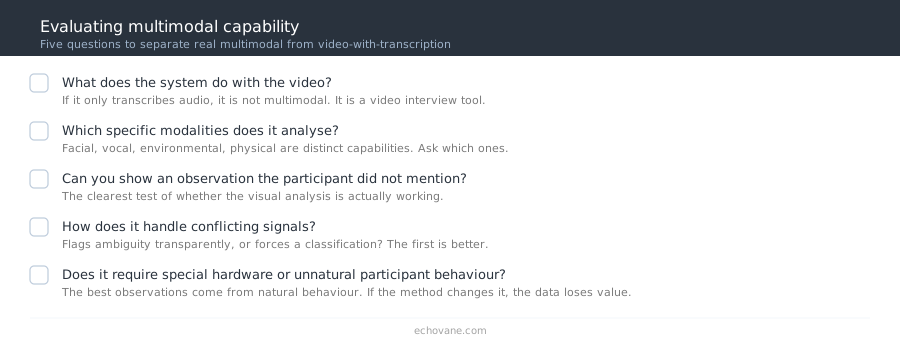
- Ask what the system does with the video. Does it only transcribe the audio, or does it analyse what it sees? A platform that records video but only processes the transcript is not multimodal. It is a video interview tool.
- Ask about the specific modalities. Facial expression analysis, vocal prosody, environmental observation, and physical interaction tracking are distinct capabilities. Some platforms do one or two. Very few do all of them. Ask specifically which signals the system analyses and how they are integrated.
- Ask for an example of an observation the AI made that the participant did not mention. This is the clearest test. If the platform cannot show you an instance where the multimodal analysis surfaced something that would have been invisible in the transcript alone, the capability is not mature.
- Ask about triangulation. How does the system handle conflicting signals? Does it flag ambiguity, or does it force a classification? The best systems are transparent about confidence levels and present contradictory signals as findings worth exploring rather than resolving them artificially.
- Ask about the participant experience. Does the multimodal analysis happen transparently within a natural conversation, or does it require special hardware, unusual setups, or participant behaviour that would not happen in real life? The most valuable observations come from natural behaviour. If the methodology changes the behaviour, it defeats the purpose.
The Bigger Shift This Represents
For as long as consumer research has existed, there has been a hierarchy of evidence. Observational data has always been considered more reliable than self-report data for understanding behaviour. Anyone who has done ethnographic work knows this instinctively: what you see people do is more trustworthy than what they tell you they do.
The problem was never the principle. It was the economics. Observational research was expensive, slow, and small. Self-report research was cheap, fast, and scalable. So most of the research portfolio defaulted to self-report, and the industry developed sophisticated techniques to try to extract behavioural truth from verbal data. Better question design. Projective techniques. Implicit measures. All valuable, all still limited by the fundamental constraint of asking people to describe things they do not consciously notice.
Multimodal AI changes the economics. Observational richness at the cost and speed of conversational research. Hundreds of participants, in their real environments, with every facial expression, physical interaction, and environmental detail captured and analysed.
This does not make the conversation less important. It makes the conversation more honest. When you can see what happened, the words become context rather than the entire dataset. The participant's verbal feedback and their observed behaviour together produce a richer, more trustworthy picture than either one alone.
For innovation teams, packaging designers, brand strategists, and insights leaders who have always known that the best data comes from watching real behaviour, this is the moment where that data becomes accessible at the scale the business needs.
Where to Start
If you are exploring multimodal research for the first time, the highest-value starting point depends on your biggest knowledge gap.
If your team regularly makes packaging decisions based on verbal feedback alone, start with a multimodal in-home usage study. Watch people actually use your product and see what the observation layer reveals that interviews have been missing.
If your ad testing process relies heavily on post-exposure recall and self-reported liking, run a multimodal ad test alongside your current approach. Compare the two and see whether the facial response data changes any of your conclusions.
If you have never done in-context ethnographic research because of cost and logistics, multimodal AI makes it accessible. Start with a small study, ten to twenty households, and see what the observational layer adds to what you already know from surveys and interviews.
The technology is ready. The question is where in your research portfolio the gap between what people say and what people do is costing you the most.
Echovane's multimodal AI platform captures facial micro-expressions, vocal signals, physical interactions, and environmental context alongside every conversation, across 65+ languages. If you want to see what your research has been missing, book a demo here.