

How to run exploratory research with AI-moderated interviews

Exploratory research is the phase of a study where the goal is to surface a frame, not test a hypothesis. Artificial intelligence (AI)-moderated interviews run this discovery by following themes wherever they lead, moving through three decisions that separate a study returning themes from one returning noise: how the guide is opened, how branching conditions are set and how the first read is structured.
This guide covers those three decisions in order. It is written for consumer insights and brand teams at large consumer packaged goods (CPG) companies who need a first frame before committing to a confirmatory study, and it covers a managed AI interview workflow rather than academic research design.
Key takeaways
- Exploratory research generates a hypothesis; confirmatory research tests one, and mixing the two in a single instrument is one of the most common failure modes in consumer research.
- A loose discussion guide opens with a situation probe rather than a question about the product, so the participant leads with a real moment from their life rather than the researcher's assumptions.
- Branching conditions work best when set on behavioural triggers, things a participant would say out loud, because behavioural triggers produce consistent probing across participants and are easier for an AI moderator to detect reliably.
- Two consecutive waves without new situational frames can be a useful review checkpoint. The researcher should assess depth, unresolved questions and coverage of relevant segments before deciding whether to end the exploratory phase.
- Clips from individual participants serve as proof that a theme is grounded in real experience, and they give stakeholders the texture of the finding that a transcript alone cannot carry.
- Echovane runs done-for-you exploratory AI interview studies: its AI moderator handles smart follow-ups, contradiction spotting and adaptive branching, while a dedicated researcher and human quality control team manage guide design, participant verification and the phased readout.
What exploratory research is and when it suits your question
Exploratory research applies when the question is unclear or poorly framed, when the team needs a frame before it can write a scale instrument, and when the goal is theme generation rather than statistical testing. It is the right design whenever you genuinely do not know what you are looking for. Feeling confident is no reason to treat it as a preliminary step and skip it.
The table below helps you diagnose the question type before choosing a method.
| Design type | The question it answers | Typical method | Output |
|---|---|---|---|
| Exploratory | Why is this happening, and what should we be looking for? | AI-moderated interviews, ethnography, open observation | A frame, a hypothesis, themes to test |
| Descriptive | What is the current state of behaviour or attitude? | Surveys, usage and attitude studies | Frequencies, distributions, segment profiles |
| Confirmatory | Does the evidence support a specified hypothesis? | Experiments or hypothesis-driven concept tests with a planned analysis | Evidence for or against the specified hypothesis |
The difference between an exploratory and a confirmatory study
Exploratory research develops possible explanations and hypotheses. Descriptive research estimates quantities such as how many people use a product or what percentage report a behaviour. Confirmatory research tests a specified hypothesis using a planned analysis; it is not defined by whether a question asks for a number or uses a rating scale. The distinction between generating and testing hypotheses is explained by the Center for Open Science.
The mistake to watch for is adding a five-point rating scale to the end of an exploratory guide for comfort. A closed item signals to the participant that the team already knows which dimensions matter, which undermines the open frame the rest of the guide was trying to create.
When exploratory AI interviews suit the question better than alternatives
Individual depth matters more than group dynamics in some studies, because focus groups surface consensus and suppress minority experience, so personal product moments or category confusion get buried before they reach the moderator. The topic may also involve personal behaviour or habitual product use that desk research cannot access. A third situation is when the question spans multiple markets or languages and coordinating human moderators across time zones adds weeks to fieldwork while introducing cross-moderator variance.
The real alternative for most insights teams today is a slow agency-moderated series running four to eight weeks before the first theme emerges, often producing a transcript that sits unread rather than a clip-based readout the team can act on. Comparing against that timeline is the more honest benchmark before comparing against other AI tools.
How to write a loose discussion guide for exploratory research
The guide opening is the highest-leverage decision in an exploratory study. A fixed survey guide tells the participant which dimensions matter. A loose exploratory guide opens a door and waits to see which room the participant walks into.
Consider a hypothetical consumer insights team at a large home-care brand. Leadership has flagged that a reformulated product is underperforming in two markets. The team knows something is wrong, but they cannot write a survey yet because they do not know whether the problem comes from product experience, shelf confusion or habit disruption, or from something the category has not named yet. That is exactly the situation this guide is built for.
For more on how screener design sets up or undermines a guide, see "The Screener Is the Study" by Himadri Roy on the Echovane blog.
Opening with a situation rather than a question about the product
A situation probe opens with the participant's lived experience and lets them lead. A category probe anchors the participant to the researcher's assumptions before they have said a word.
A category probe sounds something like this: "How do you feel about the reformulated cleaning product you bought recently?" The participant now knows the interview is about the product and about a recent purchase, with the researcher's frame imposed before they have said anything. A situation probe replaces that with an open moment from the participant's life: "Walk me through the last time you reached for a cleaning product and something did not feel right about it." The participant leads with what matters to them, and the team learns which dimension is salient before a single follow-up has been asked.
The mistake to watch for is writing three questions where one open situation probe would do. Three questions fragment the participant's narrative before it has started.
How many guide questions suit a deep exploratory study
A loose exploratory guide typically holds five to eight anchor questions rather than twenty or more items. The AI moderator follows the participant's thread with smart follow-ups rather than moving through a list, so the guide does not need to anticipate every direction the conversation might take.
Echovane supports interviews in two formats: short interviews of 0 to 30 minutes and deep interviews of 30 to 90+ minutes. For exploratory work, deeper sessions generally produce richer material, because the most useful findings tend to emerge after the participant has warmed up and moved past the surface answer. Interviews happen on the participant's own schedule rather than at a time the team controls, which matters for planning the fieldwork calendar.
The mistake to watch for is padding the guide with closed items for security. A closed item in an exploratory guide produces a count, and counts suggest a pattern the sample size cannot statistically support while missing the richest material.
Writing a screener that finds people who can speak to the question
The screener for an exploratory study qualifies lived experience rather than attitudes. Broad demographic criteria produce participants who are technically in the target but have nothing specific to say about the situation the guide opens with.
A straightforward test for each screener item is to ask whether a "yes" answer guarantees the participant has actually experienced the situation the first guide question opens with. If not, the item filters for category membership rather than situational depth. For the hypothetical home-care brand, the screener does not ask "Do you buy cleaning products regularly?" It asks whether the participant has recently experienced a moment where a cleaning product did not perform the way they expected, qualifying the experience the guide opens with.
How branching works in an AI interview study
Branching in an AI-moderated interview uses a set of conditions that tell the AI moderator when to follow a thread deeper and when to return to the next anchor question, rather than a decision tree with fixed branches mapped in advance. That distinction matters because exploratory research, by definition, surfaces themes the team did not anticipate, and a rigid decision tree cannot handle a theme that was not in the original map.
The common misconception is that branching requires the researcher to predict all theme directions before the study launches. The guide author sets a small number of conditions on the most likely behavioural triggers, leaves the AI moderator to handle smart follow-ups within each anchor and plans a guide review after the first wave.
The difference between a follow-up probe and a branch
A follow-up probe is a deepening question the AI moderator generates in response to what the participant just said. It requires no pre-specification. When a participant says "and then I just put it back on the shelf," the AI moderator follows that moment without the guide author having anticipated it.
A branch is a conditional path the guide author sets before the study. The guide author writes the trigger condition and the follow-up sequence, and the AI moderator applies them when the trigger fires. Follow-up probes handle the unexpected; branches handle the situations the team has already identified as high-priority, where consistent probing across all participants produces comparable depth.
The mistake to watch for is writing so many branches that the guide becomes a decision tree. When every anchor question carries three conditional branches, the participant's freedom to introduce unexpected themes disappears and the AI moderator is busy applying conditions rather than following the thread the participant is offering.
Setting branching conditions before a study launches
How to test it: Before writing a branch, ask whether the trigger is something the participant would say out loud, or something a researcher would have to infer from tone. If inference is required, convert the trigger into a follow-up probe on the nearest anchor question instead.
The most reliable branching conditions in exploratory work are behavioural rather than attitudinal. A behavioural trigger is something the participant would say out loud, such as "I put it back" or "I switched to the other brand." An attitudinal trigger is something the researcher infers from tone or manner, and the AI moderator cannot detect it consistently across participants.
For the hypothetical home-care brand, the team sets one behavioural branching condition before launch. When a participant describes picking up a product and not being sure it was the right one, the AI moderator goes deeper into the shelf moment and the decision process. All other anchor questions stay open.
Adjusting the guide between phases when themes shift
Clients cannot yet steer an interview live, so the team makes adjustments between phases rather than mid-session. The team reviews early interviews after the first wave, identifies emerging themes and adjusts the guide for the next phase before relaunching.
Run a first wave of ten to fifteen interviews and review the clips. Identify which anchors produced the richest material and which produced flat answers, then adjust the guide to follow the richest thread before relaunching. The phased model is how exploratory research with AI produces a usable frame rather than a large batch of undifferentiated transcripts.
The Echovane blog post "Beyond the Transcript" by Smriti Gupta covers how analysis of recordings informs next steps and supports the case for reviewing early clips before the full sample is complete.
How to read first findings from an AI interview study
The analytical step after a first wave of exploratory interviews focuses on reading for recurring situations and unexpected tensions instead of tabulation, with particular attention to moments where a participant's behaviour contradicts their stated attitude. The goal is a first frame rather than a final answer.
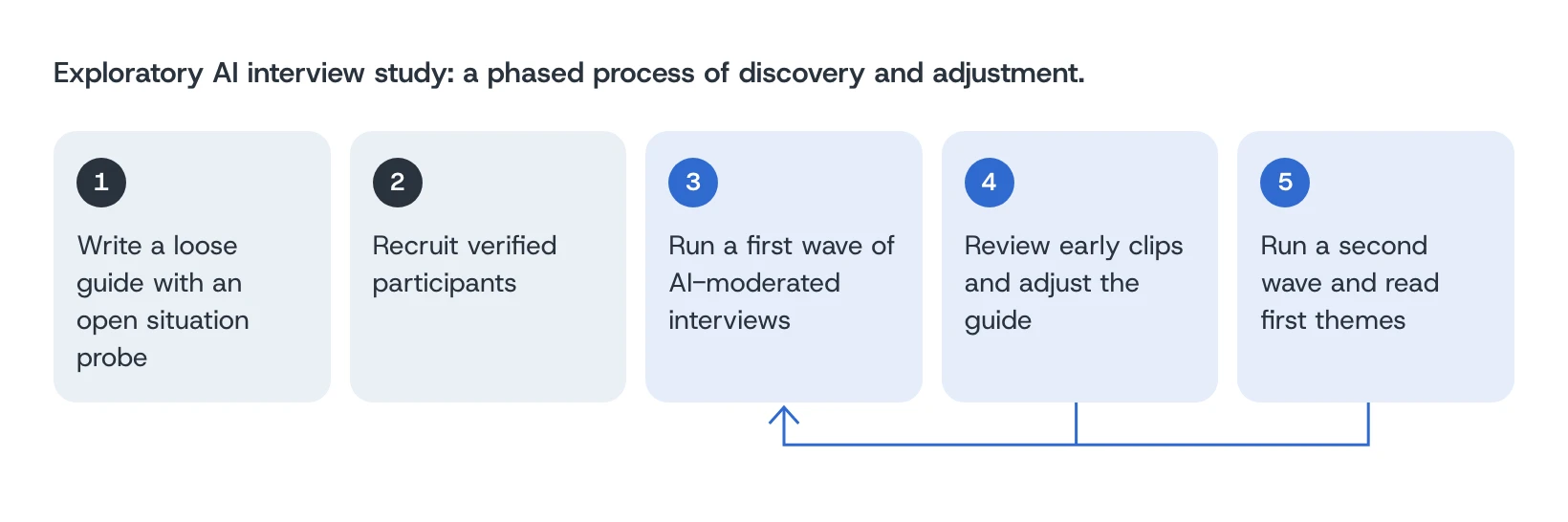
Read figure details
- Title
- Exploratory AI interview study: a phased process of discovery and adjustment.
- 1
- Write a loose guide with an open situation probe
- 2
- Recruit verified participants
- 3
- Run a first wave of AI-moderated interviews
- 4
- Review early clips and adjust the guide
- 5
- Run a second wave and read first themes
Reading transcripts for themes rather than counts
Exploratory analysis starts with reading for recurring situations and tensions rather than counting how many participants mentioned a word. Counts in a small-sample qualitative study produce false confidence, suggesting a pattern the sample size cannot statistically support. The richest material often appears in a single participant's story that challenges an assumption the whole team has been carrying.
Mark every moment where the participant described a situation the team did not anticipate, then ask what assumption about the category that moment challenges. Three participants who all described the same unexpected situation is a strong signal to follow in the next wave, not a percentage to report to leadership.
Using clips to anchor a first frame
Clips serve two functions in an exploratory readout. First, they prove that a theme is grounded in a real participant's words rather than a researcher's paraphrase. Second, they give the team an immediate sense of the texture of the experience that a transcript alone cannot carry: the tone, the hesitation, the moment a participant pauses before answering all inform the frame in ways a summary cannot.
Build the first frame around situations, not around clips selected to support a pre-existing assumption. Let the clips anchor the situations the transcripts surfaced, and let the frame hold all of them, including the ones that do not align with the team's hypothesis. For guidance on using recordings and clips as proof of a theme, see "Beyond the Transcript" by Smriti Gupta on the Echovane blog.
Deciding when the exploratory phase is finished
Thematic saturation concerns whether additional interviews add new relevant themes. A stopping decision should also consider the depth of understanding and coverage of the study question. Research by Guest, Namey and Chen describes an approach that specifies the initial interview set, the number of further interviews assessed and a threshold for new information, rather than relying on an undefined number of waves.
After each wave, list the situations and tensions, then check what the next wave adds. Two consecutive waves without new situations can be a practical review checkpoint, not a guarantee that the sample is sufficient. Before stopping, the researcher should check that relevant markets, participant segments and usage occasions are covered, that themes are understood in enough depth and that important contradictions or gaps have been followed up. If those conditions are not met, recruit or probe further.
The exploratory phase produces a frame rather than a definitive answer. With the frame ready, the team can choose the next design: descriptive research to estimate prevalence, or confirmatory research to test a specified hypothesis using a planned analysis.
How Echovane runs exploratory AI interview studies
Echovane is a done-for-you AI consumer research service. The client states the business question, and Echovane's AI agents, together with its people for review and client context, write the discussion guide and screener, recruit verified participants, run the interviews, check participant quality, analyse the results and deliver a deck with video proof plus dashboard access. Every study has a dedicated researcher and human quality control (QC).
| Phase | What Echovane does | What the team does | Honest limit |
|---|---|---|---|
| Guide and screener | Writes the loose guide with situation probes and sets branching conditions with the client | Reviews and approves the guide; provides the business question and market context | Clients cannot steer the interview live once fieldwork has started |
| Recruiting | Panel recruitment and specialised fieldwork reaching 30M+ participants across 90+ countries and 65+ languages; two-layer verification on every participant | Confirms the target profile and any specialist criteria | Niche profiles at under 0.1% incidence require specialised fieldwork beyond the standard panel |
| Interviews | AI moderator runs voice and video interviews with smart follow-ups and contradiction spotting; human team checks participant quality | Reviews early clips after the first wave; flags themes to deepen in the next phase | Interviews happen on the participant's own schedule |
| Analysis | Analyses results, identifies themes, traces each finding to the clip behind it, stores findings in Research Brain | Reviews the emerging frame and advises on confirmatory next steps | Delivery timeline depends on study complexity and market; confirm at scoping |
| Readout | Delivers a deck with video proof and dashboard access; dedicated researcher presents findings | Shares the deck with leadership; uses clips as proof in internal presentations | No norms database exists for benchmarking against past studies |
At Echovane, every participant goes through two layers of verification. Before the interview, the team checks screener authenticity, internet protocol (IP) address and location, identity and phone verification, duplicate accounts, virtual private network (VPN) and proxy usage, live human voice and human-written responses. During the interview, the AI moderator continuously evaluates response quality, monitors engagement, flags contradictions and verifies genuine category experience.
Echovane covers qualitative and quantitative research, so an exploratory wave can extend into concept testing, diary studies or ethnography from a single brief. See "One Brief, Many Methods" by Smriti Gupta for a fuller account of how that works in practice.
How to test a vendor's guide flexibility: Ask them to show a completed transcript where the AI moderator deviated from the guide order because the participant introduced an unexpected topic. A rigid system marks every deviation as a protocol error. An adaptive one follows the thread and returns to the remaining anchors.
Your next step
The hypothetical home-care team now has a path forward: one opening situation probe, one behavioural branching condition, a first wave of ten to fifteen interviews and a guide review after the first five. The second wave builds around what the clips surface. Two consecutive waves without new situational frames prompt a researcher review of depth, unresolved questions and segment coverage before deciding whether to stop or continue. The team then scopes the descriptive or confirmatory study its next question requires.
A pilot study with Echovane typically involves fifty to two hundred interviews in one or two markets, scoped on a demo call. For broader method context before you commission anything, see "AI in Consumer Research: An Insights Leader's Guide to What Actually Works in 2026" by Smriti Gupta.
Book a demo with Echovane's research team when you are ready to scope the study.
Frequently asked questions
What is exploratory research and how does it differ from descriptive research?
Exploratory research generates a frame or hypothesis when the question is poorly defined. Descriptive research maps the current state of behaviour or attitude once the dimensions are known. Echovane uses AI-moderated interviews for exploratory work and also runs large-scale quantitative studies for the descriptive phase that follows.
How many participants do you need for an exploratory AI interview study?
There is no universal participant count for an exploratory AI interview study. Two consecutive waves without new situational frames can prompt a review, but do not by themselves establish that the sample is sufficient. The researcher checks thematic depth, unresolved questions and coverage of relevant markets, segments and usage occasions. Echovane guides the decision to stop, recruit further or adjust the guide.
Can AI-moderated interviews handle the unexpected themes that make exploratory research valuable?
Yes. The AI moderator generates follow-up probes in response to what the participant says, without requiring the guide author to have anticipated the direction. Branching conditions handle pre-specified high-priority threads; adaptive follow-ups handle everything else.
How do you know when to move from exploratory to confirmatory research?
Move on when researcher review indicates that the exploratory frame is sufficiently developed for the study question: relevant segments and situations are covered, themes have enough depth and important gaps or contradictions have been explored. Two waves without new frames can be a checkpoint, not a universal stopping rule. A confirmatory study then tests a specified hypothesis using a planned analysis; a descriptive study may instead be needed to estimate prevalence.
What is the difference between a focus group and an exploratory AI interview study?
Focus groups surface consensus and suppress minority experience through group conformity pressure. Individual AI-moderated interviews let each participant lead with their own real moment. Echovane runs exploratory studies across 90+ countries in 65+ languages on the same timeline, without the cross-moderator variance a multi-market focus group series introduces.