

Most of the conversations I have with insights leaders begin in roughly the same place. They have seen a demo, they are curious whether an AI can really hold a qualitative interview together, and they want to know what that would mean for their team. It is a fair question and I never mind answering it.
It is also, more often than not, a smaller question than the one their brief is asking.
The briefs that insights leaders are working on tend to look something like this. We are launching a line extension in four markets in eleven weeks, media is booked, and we need to know whether the proposition holds, which of three creative routes to run, what the pack has to do at shelf, and why the category is losing our lapsed users. We need heavy users and rejectors. We would like to watch people shop the category instead of hearing them describe it afterwards.
That is one business question, and it is also six methods, three cohorts, four languages and two waves. Which is why the interesting problem in this category is no longer whether an AI can conduct a good interview. It is whether all of that can be held together as a single study, fielded in one window, and delivered as one answer rather than six disconnected datasets.
The Brief Is Never One Method
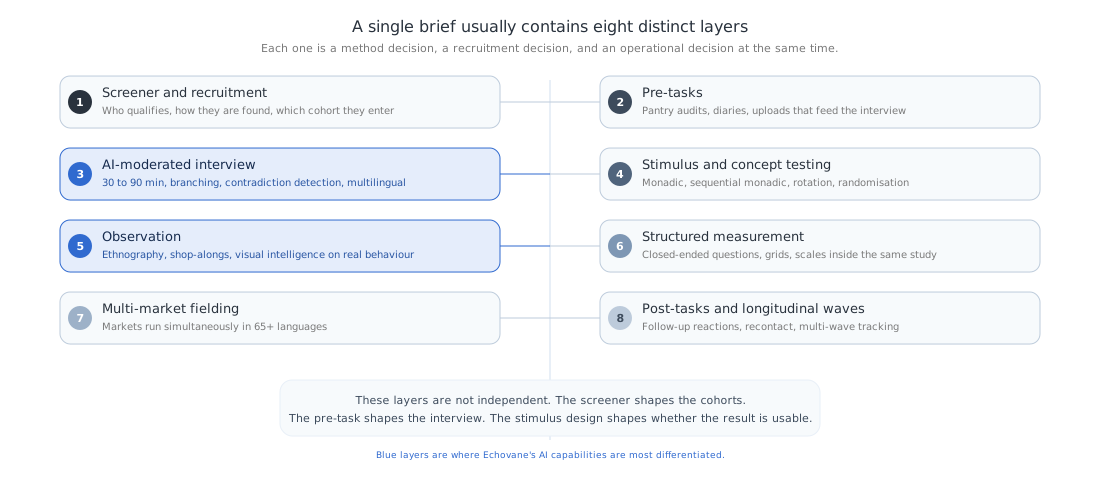
It helps to lay a brief like that out flat, because the number of moving parts is easy to underestimate until you can see them side by side.
Every one of those layers is answerable on its own, and none of them is new. The difficulty is that they are not independent of each other. The pre-task determines what the interview should ask about. The screener determines whether the comparison between cohorts means anything at all. The stimulus design determines whether the ad result is usable or quietly contaminated by order effects. Get the sequencing wrong and you do not end up with a slightly weaker study, you end up with a study that cannot answer the question it was commissioned to answer.
So when somebody asks me what we do, "AI-moderated interviews" is an honest answer that undersells the point. The interview is one layer inside a study that usually contains seven others, and a good deal of the value sits in how tightly those layers are wired to each other.
Start With the People, and Accept That There Is More Than One Kind
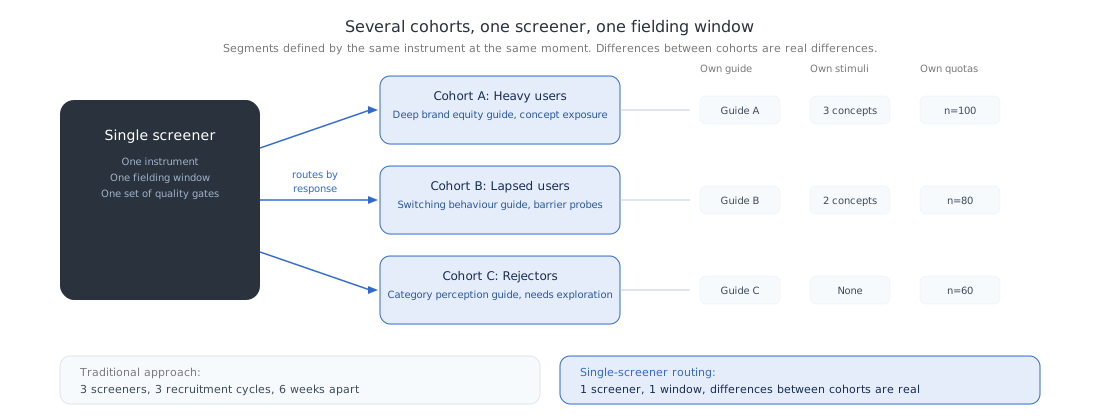
Almost every multi-method brief contains a segmentation that nobody has written down. The brief I described needs heavy users, lapsed users and rejectors, and those three groups should not be asked the same things. You can take heavy users deep on brand equity. Rejectors have no equity to probe, so half of that guide is wasted on them.
Traditionally the answer is to run three studies, which means three screeners, three recruitment cycles, three timelines and a comparison drawn across cells that went into field weeks apart.
We would rather write one screener that routes. Several cohorts can run off a single screener, each with its own discussion guide, quotas and stimulus set. The segments are defined by one instrument and fielded in one window.
When cohorts are defined by the same instrument at the same moment, the differences you find between them are differences between the cohorts. When they are defined by three screeners fielded across six weeks, some part of what you are looking at is the calendar, and I have never enjoyed the meeting where somebody asks which part.
Pre-Tasks: The Interview Starts Before the Interview
Some of the most useful material in a qualitative study is produced before anybody has been interviewed.
A pre-task is any activity a participant completes ahead of the session, answered over voice, video, text, photo or upload. A pantry audit, a week of receipts, a brand love letter, a short film of the last time they used the product, or something they are comfortable sharing from their own social feeds or AI chat apps.
One obvious benefit is that participants arrive warm rather than cold. The benefit I care about more is what a pre-task does to the interview itself, because it can be wired so that whatever happens inside it changes the probes in the session. If a participant films a pantry audit, the interview can ask about what was observed in that pantry, not about pantries in the abstract. That is a different conversation, and it moves people off the narrative they rehearsed on the way to the session.
Post-tasks work the same way in the other direction. A reaction captured a week after exposure has survived a week of ordinary life, which is more than can be said for a reaction captured thirty seconds after it.
The Interview: Long, Conversational, and Able to Change Route
Three things decide whether the interview layer is carrying its weight.
It Has to Be Able to Run Long
We regularly run studies at ninety minutes, and the platform will sustain two and a half hours, though we do not recommend it and rarely suggest it. Length on its own is not a virtue and a long interview is not automatically a good one. What matters is that the length is available when the research question needs it, because a great deal of the most useful qualitative material arrives in the second half of a conversation, once the rehearsed answers have run out.
It Has to Remember
Holding a ninety-minute conversation together is a harder engineering problem than it appears, and the usual failure is that response times creep upward as context accumulates until the exchange stops feeling like a conversation at all. Our system holds context across the full session with response times that typically stay under a second and do not degrade as the interview runs on.
The research consequence of that is very specific. If a participant says something in the fifth minute and contradicts it in the seventieth, the moderator remembers and probes the contradiction. Contradictions are rarely noise in qualitative work. They usually mark the distance between how somebody wants to be seen and how they behave, which tends to be the most interesting thing in the transcript.
It Has to Be Able to Change Route
Most tools in this category offer contextual follow-up, where the participant answers, the moderator probes deeper on that answer, and the guide then returns to its planned path. We do that too, and I would consider it table stakes.
Branching into a whole sub-topic is a different capability. A participant tells you that three of eight possible features matter to them, and the guide opens a set of questions built around those three, which a participant who chose differently will never see. Or a participant picks two ads out of a cluttered set, and the guide brings those two back and goes considerably deeper on them. The route through the study changes according to what the participant said.
One further point, because it is the part participants themselves comment on. The moderator works over video and voice in the way a video call does, with no typing, no wall of text to read and no button to press before speaking. That sounds cosmetic and it is not. Every interface element sitting between a participant and their own train of thought costs you depth.
Stimulus: Testing Concepts and Creative Without Designing in the Bias
The moment a study includes ads, packs or concepts, how the exposure is designed matters as much as what you ask about it afterwards.
We support the sequencing that work requires: monadic and sequential monadic designs, rotation across a concept set, randomisation, and the other standard approaches for removing order bias. Stimuli can be audio, video, image or text, and can be sequenced within a single session.
This is unglamorous, and it is where a surprising number of AI research studies come apart. If every participant sees concept A first, you have measured concept A plus the advantage of going first, and no amount of analysis afterwards will separate the two.
Observation: What People Do, Rather Than What They Report
Self-report has a ceiling and most researchers know roughly where it sits. People tell you what they remember, what they believe is relevant, and what they are willing to say out loud. A good deal of the most valuable material is in what they never think to mention.
This is the main reason Echovane is more than an AI-moderated interview platform. We run self-ethnographies and digital shop-alongs, and our visual intelligence can analyse what participants are doing and not only what they narrate: the product pushed behind three others, the awkward grip they adapted to years ago and stopped noticing, the half-second hesitation at shelf that suggests the decision is less automatic than the story they tell about it.
In practice these methods are usually blended rather than run alone. Pairing a shop-along with an AI-moderated interview is one of the combinations we see most often, because the observation supplies the specifics and the interview supplies the reasoning behind them.
Structure Where You Need It, and Markets Where You Need Them
Two smaller layers turn up in almost every real brief.
One is structure. Qualitative studies frequently need some closed-ended measurement inside them, whether to satisfy a stakeholder or to size something the qualitative has surfaced. Closed-ended questions can be asked within the same study, including grid questions where the design calls for them. The aim is not to turn qual into quant. It is that you should not have to field a separate survey to put a number against something you already have the right people for.
The other is geography. EchoAI conducts interviews natively in more than sixty-five languages, and our recruitment network reaches over twenty million respondents in more than ninety countries. What that changes operationally is that markets run at the same time instead of one after another. The old pattern of global qual, where markets field sequentially because moderator availability forces it and translation chains add weeks at the end, is the single biggest reason multi-market studies get cut for time.
Where Multi-Method Studies Actually Break
Here is the part I think gets discussed least. Multi-method studies rarely fail on method. Every layer I have described is individually well understood and has been for decades. They fail on operations.
They fail because the pre-task platform is separate from the interview platform, so the pantry audit never reaches the moderator. They fail because the screener for the third cohort gets written three weeks after the screener for the first. They fail because the person coordinating four markets is the same person expected to analyse the output, and there are not enough hours in the week. They fail because one piece slips and the launch date does not.
Which is why I would argue that the service model matters at least as much as the technology, and it is the reason we built our service the way we did.
What Done For You Actually Means
In practice the arrangement is this.
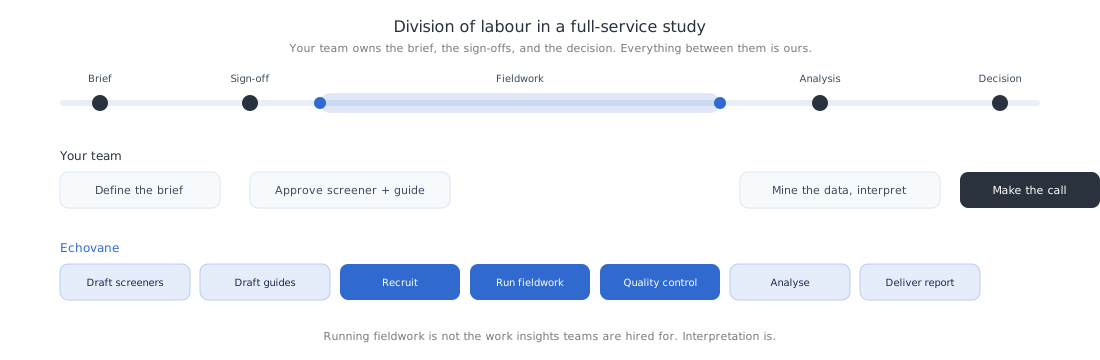
You will never have to open the platform while the research is running, unless you want to. We help write the screeners and the discussion guides. The final decisions on both are always yours. We handle recruitment, fieldwork, quality control and analysis. You open the platform once fieldwork is done, because that is the point at which there is something worth mining, and where the analysis tooling starts to earn its place.
We draw the line there rather than earlier because running fieldwork is not the work insights teams are hired for. Nobody's job description says coordinate four markets and chase quota fill. The judgement, the interpretation and the argument you eventually make to your stakeholders are the parts that only you can do, and they are the first things to get squeezed when fieldwork operations take over a calendar.
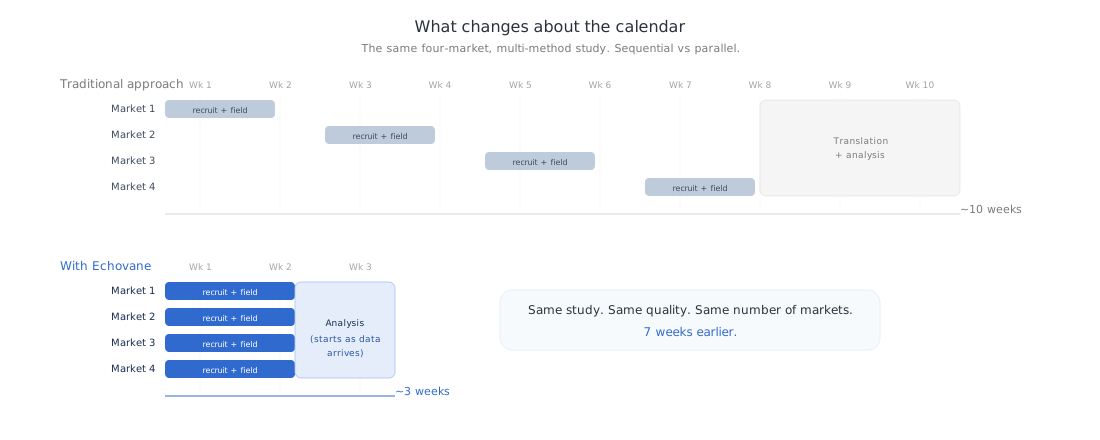
What This Changes About the Calendar
All of this is really about timing. The true cost of slow research is not the budget, it is irrelevance, and an insight that arrives after the decision has been taken is an expensive document.
When the layers run in parallel instead of in sequence, and when the operational load sits with the provider instead of the client team, the shape of a project changes. Markets field at once. Hundreds of interviews run simultaneously without any one of them receiving less attention than the first. Analysis begins as transcripts arrive, not after the last market closes. The cycle from brief to a report your stakeholders can act on runs in days rather than the six to eight weeks a comparable multi-method study has traditionally taken.
That is what makes the ambitious version of a brief affordable in time, and time, not method, is usually why the ambitious version gets cut back to interviews alone.
The Honest Limits
A few things worth stating plainly, since a piece like this is not much use if it only lists strengths.
Multi-method does not mean every method every time. The most common problem I see in briefs is layered-in methods that do not serve the decision, and a study with three well-chosen layers will usually beat a study with seven.
Group dynamics remain a real gap. If your question is about how opinions form in a group, how social influence works, or how people build on each other's ideas, a well-run focus group with a skilled moderator is still the right instrument, and we are not trying to replace it.
Longer is also not better by default. Ninety minutes is a tool rather than a target. Most studies do not need it, and a study that runs long without a reason produces a bigger transcript rather than a better one.
Where This Leaves Us
The question in this category has moved. Whether an AI can conduct a good interview is now largely settled, and the answer is yes, within limits that are worth understanding.
What I find more interesting is whether a research partner can hold a complicated brief together from end to end. Several cohorts. Pre-tasks that feed the interview. Observation alongside conversation. Stimulus sequenced properly. Structured measures where a stakeholder needs them. Several countries at once, two waves, and one deadline that will not move.
That is what most real research looks like, and it is what we built for.
If you have a brief with more than one method in it and a date attached, I would be glad to talk it through. Book a demo.