


Ask a room of researchers where studies go wrong and you will hear about discussion guides, about analysis, about stakeholders who wanted the answer before fieldwork had started. All of those are real.
The failures I find most expensive happen earlier and much more quietly, in recruitment. A cell fills up with people who technically qualified and are not really the audience. A B2B study reaches people whose job titles were aspirational. A six-market study ends up with six subtly different readings of the same segment. None of it is visible at the time, because fieldwork completes and the transcripts look perfectly reasonable. It surfaces weeks later in analysis, as a set of findings that will not resolve into anything you would want to put in front of a leadership team.
Recruitment is the part of a study where the cost of being wrong is highest and the feedback is slowest, and I think it deserves considerably more attention than it tends to get.
Difficulty Is Not One Thing
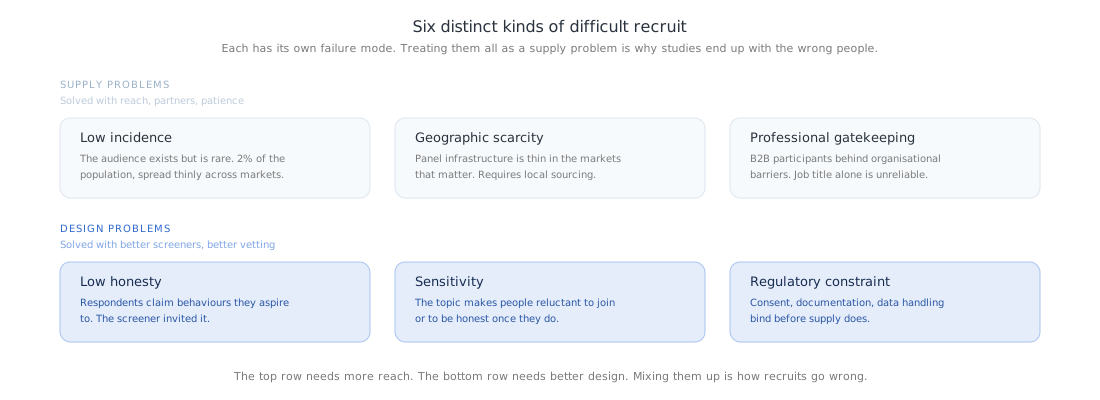
The phrase "hard to reach" flattens at least six different problems, and because they fail in different ways they need different responses.
The distinction that matters most in practice is between low incidence and low honesty. Low incidence is a supply problem, and supply problems are solved with reach, partner panels and patience. Low honesty is a design problem, and no amount of reach will fix it. If your screener asks people whether they are health-conscious shoppers, you will fill the cell with people who like the idea of themselves as health-conscious shoppers, which is a different population from the one you meant, and you will not find out until the interviews start contradicting each other.
There are at least four other distinct types of difficulty beyond these two. Geographic scarcity, where the audience exists but is thinly distributed across markets. Professional gatekeeping, where reaching B2B participants means getting past organisational barriers. Sensitivity, where the topic itself makes people reluctant to participate or to be honest once they do. And regulatory constraint, where consent and data handling requirements limit who can be recruited and how.
Each of these fails differently, and treating them all as a supply problem is why studies end up with the wrong people in them.
Where Participants Actually Come From
There is a tendency in this industry to talk about panel size as though it settled the question. It does not, though it is a real part of the answer, so here is ours.
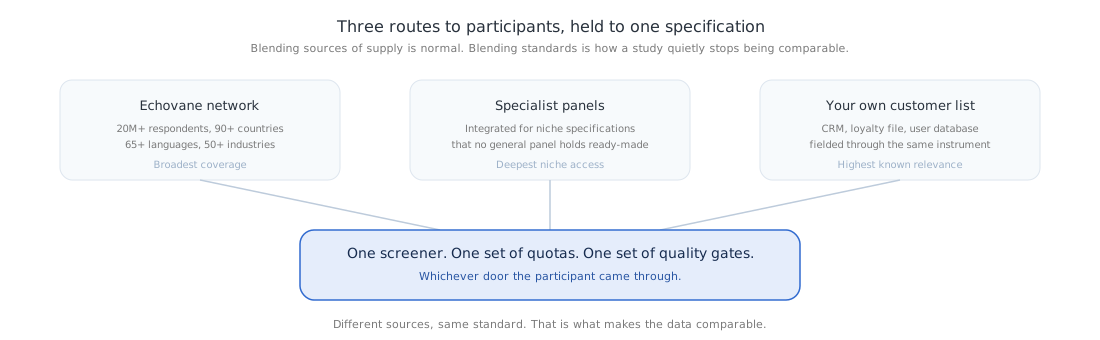
Our own network reaches more than twenty million respondents in over ninety countries and more than sixty-five languages, spanning fifty industries, a hundred job titles and a thousand skills. That covers a very wide range of consumer and professional specifications.
It does not cover everything, and I would be wary of anyone who told you their panel did. For the genuinely niche recruits we integrate with specialist qualitative panels, and we run our own recruitment for specifications that no panel holds ready-made. For a good proportion of studies the right sample is not a panel at all, it is your own customers, users or loyalty file, fielded through the same instrument and held to the same standards as everything else.
The last point is the important one. Drawing on several sources of supply is normal and sensible. Letting each source bring its own definition of the segment is where studies quietly stop being comparable. One screener, one set of quotas, one set of quality gates, whichever door the participant came through.
Write the Screener Around Behaviour, Not Self-Description
If there is one thing in this article worth taking away, it is this. Most bad recruitment is caused by screeners that ask people to categorise themselves.
Some of the principles we work to.
Ask what somebody did, not what they are. "How many times in the last four weeks did you buy X" is a better question than "would you describe yourself as a regular buyer of X," because the first has an answer and the second has an aspiration.
Do not signal what you are looking for. If the desirable answer is visible in the question, a meaningful share of respondents will find it. This is not fraud, it is ordinary human helpfulness, and it contaminates cells just as effectively.
Put the hardest criterion first. If the study needs a low-incidence behaviour, screen for it before you spend anybody's attention on demographics.
Use recency alongside frequency. "Ever" is doing very little work in most screeners, and a behaviour from four years ago belongs to a different participant from a behaviour from last week.
Ask the same thing twice, phrased differently, when the stakes justify it. Inconsistency between two versions of the same criterion is a useful signal.
Handle category exclusions properly. Competitor employment, recent research participation and industry adjacency all matter more than they usually get credited for.
None of this is new, it is standard qualitative craft. It gets skipped because screener writing is unglamorous and usually happens under time pressure, which is exactly why it belongs with the provider instead of being handed back to a client team at eight in the evening. We draft screeners as part of the study, and the final call on them is always yours.
The Vetting Stack, and Why the Last Gate Is the Interview
Bad panel data contaminating a study is a story most researchers can tell you some version of. We treat it as a first-order problem.
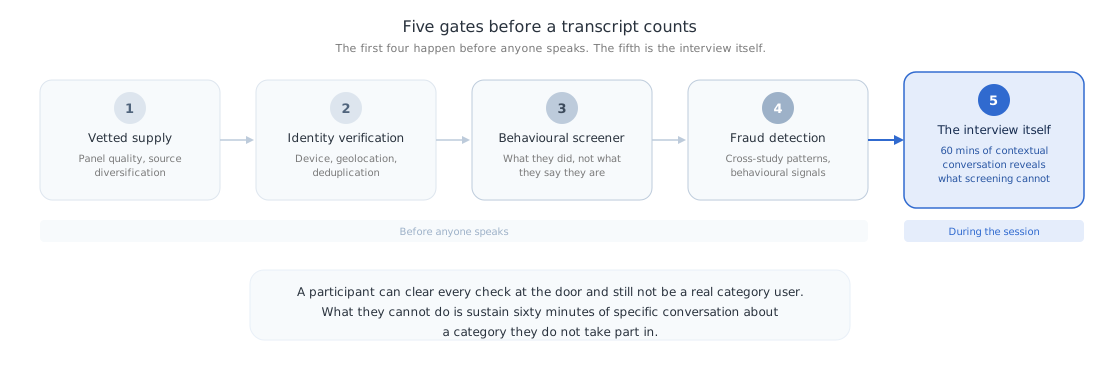
Participants pass through several gates before their transcript counts toward the study. The first four are the ones you would expect and all of them are necessary: vetted supply, identity verification, a behavioural screener written to the principles above, and fraud detection that catches patterns human screeners miss, including some that only become visible across many studies rather than within one.
The fifth is the one I would argue about with anybody. The interview itself is a quality gate, and it is the strongest one available to us.
A participant can clear every check at the door and still not be a real category user. What they cannot do is sustain sixty minutes of specific, contextual conversation about a category they do not take part in. EchoAI is evaluating engagement and coherence across the whole conversation, so somebody who is disengaged, internally contradictory, or clearly not the person the screener described becomes visible in a way that five screening questions could never reveal.
That is a different standard of quality control from checking a handful of questions at the top of a survey, and it is one of the few advantages of a long AI-moderated interview that has nothing to do with speed or cost.
Several Cohorts, One Screener
Complex recruitment frequently means several audiences at once. Heavy users and rejectors. The person who purchases and the person who actually consumes. Decision-makers and influencers inside the same household or the same buying committee.
Running those as separate studies is the traditional approach and it introduces a specific analytical problem, which is that the segments were defined by different instruments, fielded in different windows, on different bases. Some proportion of the difference you find between them is method, and you will not be able to say how much.
We route cohorts off a single screener instead. Screener responses determine which cohort somebody enters, and each cohort can carry its own discussion guide, its own stimulus set and its own quotas. Everybody is defined by the same instrument in the same window, so when you find a difference between cohorts you are looking at a difference between cohorts.
Multi-Market Recruitment: One Specification, Many Countries
Multi-market qualitative research has a recruitment problem that is separate from its fieldwork problem, and it gets less attention because the fieldwork problem is louder.
The recruitment problem is drift. A specification written in one market gets locally interpreted in the other five. Category definitions vary, purchase channels vary, and what counts as a heavy user in a mature market is a different behaviour from what counts as one in a growth market. If nobody makes that judgement explicitly, each market makes it independently and silently.
Two things help. The first is holding one screener as the source of truth and making local adaptations deliberate and documented rather than emergent. The second is fielding markets simultaneously rather than sequentially, which is possible because EchoAI conducts interviews natively in over sixty-five languages instead of translating after the fact. Simultaneous fielding removes an entire class of drift, because there is no six-week gap in which the category itself can move underneath you.
Regulated, Sensitive and Consent-Heavy Categories
Some recruits are difficult for reasons that have nothing to do with finding people.
Pharmaceutical, infant nutrition, alcohol, financial vulnerability, health claims, anything touching minors: in these categories the binding constraint is consent, documentation and data handling, and it binds long before supply does. We handle participant consent within the research workflow itself and follow defined retention and deletion protocols. We are SOC 2 compliant and ISO 27001 certified, with end-to-end encryption and granular access controls.
That is not a compliance paragraph written for the procurement conversation. In these categories it determines whether the study can run at all, and it is worth establishing before anybody starts drafting a discussion guide.
Longitudinal and Recontact: The Wave That Quietly Collapses
Longitudinal designs have a failure mode that is well known and still routinely underestimated, which is attrition.
Wave one goes well. Wave two comes back at a fraction of the sample, and the fraction that returns is not random. The people who come back are the people most engaged with the category, which is exactly the bias the design was meant to avoid.
The fixes are not sophisticated and they work. Over-recruit at wave one with the attrition rate assumed rather than hoped away. Secure recontact consent at the point of first participation, not by chasing it later. Keep the burden of each wave proportionate to what it will tell you. Use lighter post-tasks between waves to hold contact without asking for another full session. And describe the returning sample honestly instead of presenting it as though it were the original one.
What We Say No To
A short section, and I think a necessary one.
We will tell you when a specification is too narrow to fill in the timeline you have, rather than filling it loosely and letting you discover the problem in analysis. We will tell you when a screener as written will recruit the wrong people, and propose the behavioural version instead. When a recruit needs a specialist panel we do not have direct access to, we would rather say so than approximate it with the closest available audience.
The reasoning is self-interested as much as principled. A study recruited loosely does not fail visibly. It fails as a set of findings nobody quite trusts, which is a worse outcome for everyone than a difficult conversation about feasibility at the start.
Where This Leaves Us
Recruitment is the part that determines whether the interesting methodological work means anything.
The questions worth putting to a research partner about recruitment are not really about panel size. They are: how is the screener written, and by whom. What happens when a market interprets a criterion differently. What catches a participant who qualified on paper and does not belong in the study. And how much of that work is going to land back on your team.
If you have a specification that has been called impossible, or one that has quietly gone wrong before, I would be glad to look at it with you. Book a demo.