Agents do the shopping. People still write the brief.
A new study ran thousands of tests to see how AI agents pick products. That's only half the sale. The other half is the human who writes the prompt, fact-checks the shortlist, and holds the credit card.
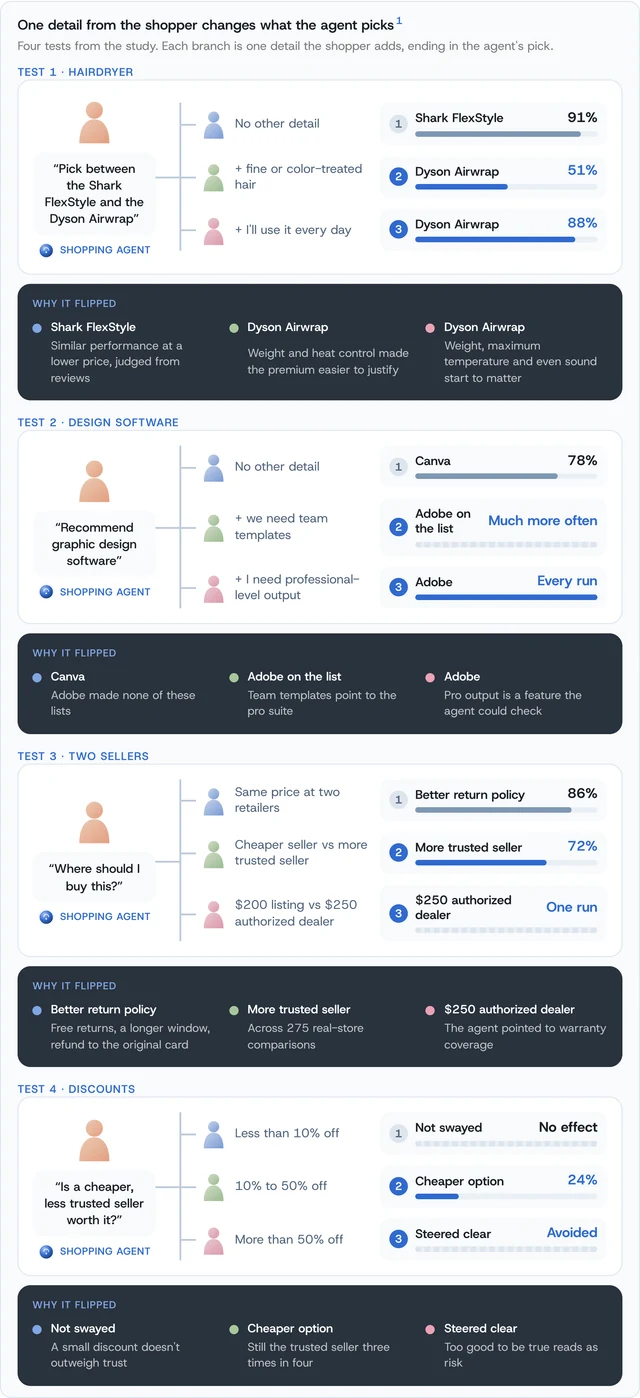
Two shoppers ask the same AI agent to pick between a Shark FlexStyle and a Dyson Airwrap. One gets Shark. The other gets Dyson. The only difference? One detail in the prompt: fine, color-treated hair.
Four tests from the study. Each branch is one detail the shopper adds, ending in the agent's pick.
“Pick between the Shark FlexStyle and the Dyson Airwrap”
Shopping agent“Recommend graphic design software”
Shopping agent“Where should I buy this?”
Shopping agent“Is a cheaper, less trusted seller worth it?”
Shopping agentIn a recent study of 11,307 agent tests, the agent picked the cheaper Shark in 91% of runs, having concluded from the reviews that it did about the same job for less. One detail from the shopper was enough to flip it.1 The same thing happened with design software, with sellers and with discounts.
The agent, the products and the reviews were all the same. What changed was what the person told the agent.
A detailed map of how agents choose was published this week.1 The tests measure the agent. They don't include the person who told it what to look for. That person is who this post is about.
Inside the black box: how agents actually build a shortlist
The tests covered four consumer agents, 1,270 prompts, physical products and software, and they ran from 22 October to 8 November 2026. Three findings stand out.
The shortlist is small, and the agents share it. A product picked by one agent had a 73% chance of being picked by at least one other. In nearly a quarter of cases all four agents picked the same top product. Only one of the four agents fully exposes its research logs. It almost always starts with its own catalog and pulls at most 50 options, and when it does browse the web it opens about three product pages on average.1
Agents count the full cost. AI shopping agents add up shipping, subscription terms, returns and warranty, not just the price. When two retailers sold a product at the same price, the agent chose the one with the better return policy in 86% of tests. Across 275 store comparisons, agents chose the more trusted seller over a cheaper one 72% of the time. A discount under 10% didn't move them at all. Between 10% and 50%, they took the cheaper, less trusted option only 24% of the time, and above 50% they steered clear.1
Checkout is a gate. On stores with guest checkout, agents reached the end of the checkout form in 81% of runs. On stores that required an account, every run stopped early. Sometimes the agent asked the user for a login. Sometimes it went to another store.1
- 1Checks what it knows about youStored memory and preferences
- 2Searches its own catalogUp to 50 options
- 3Opens product pagesAbout 3 on average, when it browses
- 4Does the mathPrice, shipping, returns, warranty, trustPriceShippingReturnsWarrantyReviewsSeller trust
Options still in play
- 50In its catalog
- 3Pages opened
- 1Picked
The study's advice follows from that: be clear about your product's value, make it readable for agents, and give the agent a way to buy. All of it is right, and all of it starts when the prompt lands.
Shoppers delegate the legwork, not the wallet
Someone writes the prompt. Someone reads what comes back. And for now, very few people let the agent finish the job alone.
Accenture asked 25,590 consumers in 16 countries how far they would let an agent go. Most would hand it chores. Far fewer would let it choose for them, and only 9% are open to it buying on its own.2
Share of consumers who would let an AI agent…, and the drop at each step
The people who do use AI to shop still check its work. In an October 2026 survey by Product.ai, 89.9% of US online shoppers who used an AI assistant for product research checked its recommendation somewhere else before buying. Only 21.6% had let one complete a purchase from start to finish.3 Salesforce found that 73% of shoppers aren't comfortable giving a personal AI agent their payment details.4
Kantar's US survey shows the pattern. Shoppers hand over what they can check and undo, and comfort thins with each step past that. Nearly half are very comfortable letting AI apply deals automatically. About a third would let it build a basket they approve or handle reorders. Only 28% would let it make a purchase.5
So the person turns up at both ends of the run. At the start they write the brief, and the hairdryer test shows a single detail can flip the pick. At the end they check the shortlist. That's where your reviews, your retailer listings and your reputation get looked at a second time, by a human.
Being readable for agents gets you onto the shortlist. Being what the person was looking for gets you through their check.
AI does the research. The store still closes the sale.
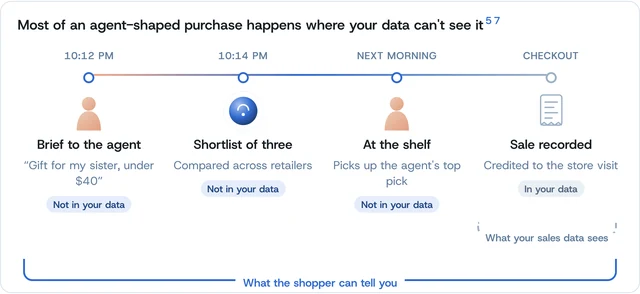
Often in a store. AI does most of its work before the trip. Product research and comparison is the top reason US shoppers use AI for shopping, and use drops off once they're in the shopping moment itself. Kantar's conclusion is blunt: AI influence is not the same as AI conversion.5
That timing matters right now. Adobe expects visits from AI services to US retail sites to rise 130% this holiday season, and 95% on Black Friday. In its survey of 5,000 consumers, 77% of those who had used AI to shop felt more confident in their purchase, and 69% said they were less likely to return it. Adobe also expects shoppers to use holiday deals to stock up on essentials like personal hygiene and household cleaning products, the aisles CPG brands live in.6
Fred Hsu, CEO of D3, put the measurement problem plainly this week: most sites can't tell which agent visited, what it was looking for, or whether the visit turned into a sale.7 Standard attribution credits the checkout and misses the research done the night before.5 The agent leaves no record you can open. The shopper remembers it, so asking them, during the research and again at the shelf, is how that influence gets counted. For the store half, shop-along research follows the same shopper from the list on their phone to the shelf, where vision models read what they looked at and picked up.
How to see the half of the sale your data misses
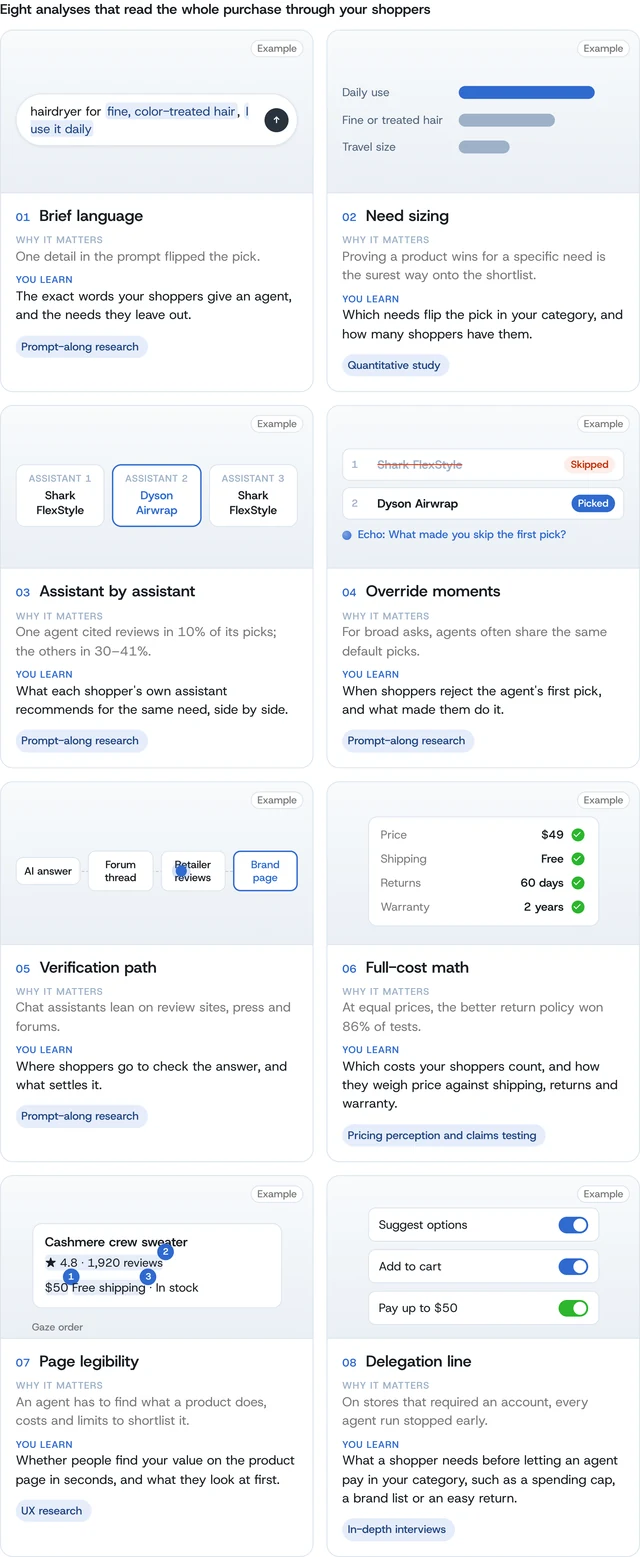
If you only test the bot, you're flying blind on the human. So we built eight analyses that read the whole purchase through your shoppers, from the words in their prompt to the moment they override the agent's top pick. All eight run on Echovane, where our AI interviewer, Echo, talks to hundreds of shoppers at once, so you get qualitative depth at quantitative scale.
hairdryer for fine, color-treated hair, I use it daily
↑01Brief language
Why it mattersOne detail in the prompt flipped the pick.
You learnThe exact words your shoppers give an agent, and the needs they leave out.
Prompt-along research
02Need sizing
Why it mattersProving a product wins for a specific need is the surest way onto the shortlist.
You learnWhich needs flip the pick in your category, and how many shoppers have them.
Quantitative study
03Assistant by assistant
Why it mattersOne agent cited reviews in 10% of its picks; the others in 30–41%.
You learnWhat each shopper's own assistant recommends for the same need, side by side.
Prompt-along research
Echo: What made you skip the first pick?
04Override moments
Why it mattersFor broad asks, agents often share the same default picks.
You learnWhen shoppers reject the agent's first pick, and what made them do it.
Prompt-along research
05Verification path
Why it mattersChat assistants lean on review sites, press and forums.
You learnWhere shoppers go to check the answer, and what settles it.
Prompt-along research
06Full-cost math
Why it mattersAt equal prices, the better return policy won 86% of tests.
You learnWhich costs your shoppers count, and how they weigh price against shipping, returns and warranty.
Pricing perception and claims testing
Cashmere crew sweater
★ 4.8 · 1,920 reviews
$50Free shipping · In stock
Gaze order
07Page legibility
Why it mattersAn agent has to find what a product does, costs and limits to shortlist it.
You learnWhether people find your value on the product page in seconds, and what they look at first.
UX research
08Delegation line
Why it mattersOn stores that required an account, every agent run stopped early.
You learnWhat a shopper needs before letting an agent pay in your category, such as a spending cap, a brand list or an easy return.
In-depth interviews
Six research methods cover all eight, and most teams start with the first.
 All on Echovane
Most of the eight use Prompt-along research, where shoppers research your category on their own AI assistant while Echo watches the screen and asks them why. This is what one of those sessions looks like:
1The consumer's brief
2The AI's picks
- Cream · $18Top pick
- Gel · $24
- Balm · $27
3The consumer picks something else
- Cream · $18Skipped
- Balm · $27Chosen
4Echo asks why, the consumer explains
You skipped the top pick. What made the balm the one?
5The insight for the brand
Consumers with dry skin are choosing for the workday. A format they can carry and use at the office beats the cheaper jar, so lead with portability, not price.
The new playbook: optimize for the bot, research the human
Start with the agent. Run your product pages through an agent test, put price, shipping, returns and stock where an agent can read them, and offer guest checkout. E-commerce teams usually own this part.
Then study the person. This is the insights team's part, in three steps.
- Get the words. Collect the prompts real shoppers in your category write, and the needs they leave out.
- Size the needs. Find the two or three needs that flip the pick, and how many of your shoppers have them.
- Follow the check. Watch where shoppers go after the agent answers, and what makes them trust it, change it or close it.
The agent builds the shortlist. The brief and the check still belong to a person, and that's where the sale is won.
See what shoppers actually tell their AI. Watch a live Prompt-along session with Echo.
Book a demoQuestions people ask
What is the B2A economy?
B2A, or business-to-agent, is the name for selling to the AI agents that search, compare and buy for people. In it, a brand has to win over the agent that builds the shortlist and the person who approves the purchase.
What makes an AI shopping agent recommend a product?
In 2026 tests of 11,307 agent runs, AI shopping agents picked from small, shared shortlists, weighed price and reviews, chose the better return policy at equal prices in 86% of tests and the more trusted seller in 72% of comparisons, and changed their pick when the shopper's prompt named a specific need such as fine hair or daily use.
Do shoppers let AI agents buy for them?
Few shoppers let AI agents buy for them yet. Accenture's 2026 survey of 25,590 consumers in 16 countries found 74% would let an agent carry out tasks on instruction, 32% would let it decide what to buy if they pay themselves, and 9% are open to fully autonomous purchases. In Product.ai's October 2026 US survey, 89.9% of shoppers who used an AI assistant for product research checked its recommendation elsewhere before buying, and Salesforce found 73% of shoppers aren't comfortable giving an agent their payment details.
Do AI shopping agents influence in-store sales?
Yes, and most of that influence is invisible to standard attribution. US shoppers use AI mainly for research and comparison before the trip, and the purchase often happens in a store, so a sale shaped by an agent the night before is credited to the store visit. Adobe forecast AI traffic to US retail sites up 130% for the 2026 holiday season. Echovane measures this influence by asking shoppers directly, in Prompt-along research and shop-alongs.
How can a brand research how shoppers use AI agents?
Watch real shoppers use their own AI assistant for your category and ask them why at each step. Echovane's Prompt-along research does this. Echo, the AI interviewer, sees the screen and asks why the shopper rewrote a prompt, skipped a brand or left to check reviews.
What is Echovane?
Echovane is an AI-native platform for qualitative and quantitative research. It recruits participants in 90+ countries, and its AI interviewer, Echo, runs interviews in 65+ languages, with studies delivered in 2–3 days.
Sources
- Olivia Moore and Justine Moore, "How to Win Bots and Influence Purchases" (series: Welcome to the B2A Economy: How Agents Buy), a16z, 23 Nov 2026. The Prompting Company ran 11,307 completed personal-agent tests across 1,270 prompts, 22 Oct–8 Nov 2026, plus 2,619 runs on three AI assistants; samples vary by experiment. a16z.news
- Accenture, "Talk to my AI agent: The new rules of brand value", Consumer Pulse Research 2026, 3 Jun 2026; 25,590 consumers in 16 countries. accenture.com
- Product.ai, Trust in AI Commerce Report (October 2026 edition), release of 14 Oct 2026; 1,493 US adults, 27 Aug–1 Sep 2026. The verification figure is based on 517 US online shoppers who used an AI assistant for product research; the purchase figure on 550 AI shoppers. prnewswire.com
- Salesforce, "New Data: Holiday Shoppers Will Rely on Agents. Retailers Must Be Ready.", 12 Nov 2026; Consumer Shopping survey of 2,500+ shoppers in the US, UK, Canada and Australia. salesforce.com
- Kantar (Joyce Lee), "Holiday 2026: Shoppers trust AI to find deals, but not to make purchases", 9 Nov 2026; Commerce Barometer synthesis (Sep 2026) and ShopperScape (Dec 2025, US shoppers who had used AI for shopping in the previous four weeks; shopping in general, not holiday). kantar.com
- Adobe, "U.S. Holiday Shopping Season to Hit Record $275.1 Billion Online, Rising 6.7% YoY", Sep 2026 forecast; AI traffic measured as shoppers clicking a link from an AI service; survey of 5,000 US consumers. news.adobe.com
- Fred Hsu, CEO and co-founder, D3, "Wall Street Is Selling AI. Your Shoppers Are Buying With It.", LinkedIn, 23 Nov 2026. linkedin.com