

Customers open up in their native language. That's where the deeper insights are.
Brands growing into Europe, Asia-Pacific, China and Latin America often run research in one language per market. Customers answer, but they hold back. Here's why the conversation goes deeper in their native language, and how we recruit and interview people in it, dialects included.

When a brand asks us to run a study in Manila, they usually expect the interviews to be in English, because most Filipinos speak it. Then they hear the recordings. In English, people give short, polite answers. When they switch to Taglish, mixing Tagalog and English in the same sentence, they start explaining: why they changed brands, who at home decides, what actually bothered them.
We see the same thing in every market. Speak to customers in their native language and they open up. The conversation goes deeper, and so do the insights. Buying works the same way: in RWS's 2023 survey of 6,500 consumers in 13 countries, 82% said a lack of local-language support would stop them buying in at least one category.1 An interview asks for far more than a purchase does. Below: why people open up in their native language, and how we recruit and interview them in it.
More of the brands we work with now grow in markets they didn't grow up in. In those markets, local brands set the pace.2, 3, 4
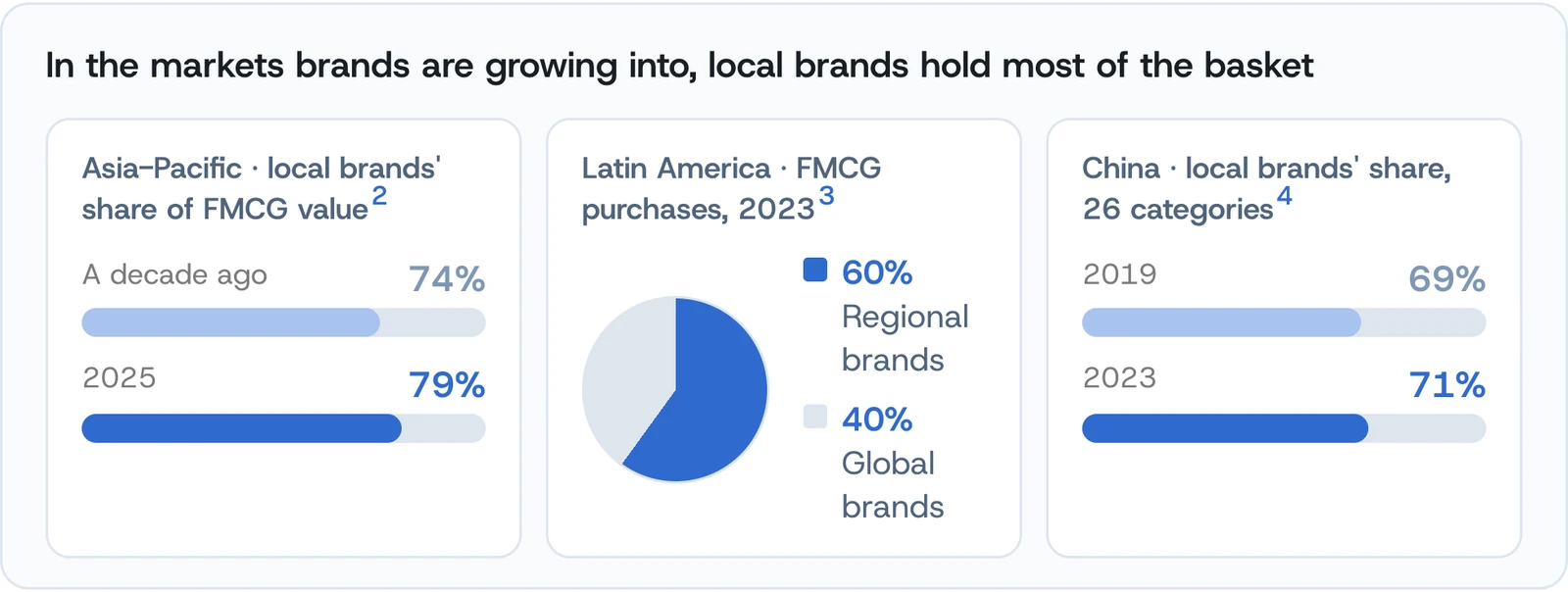
Local brands hear their customers every day, in their native language. A brand entering a market for the first time can do the same, and that starts with who it can reach and in which language.
Why do customers open up in their native language?
Customers open up in their native language because it is the language they think in, so they give reasons and feelings, not only the polite answer. In a second language, people say what is easy and polite to say. In their native language, they say what they mean, and the interviewer can follow up on it. That follow-up is where deeper insight comes from: the real reason behind a switch, the word customers use for a product, the worry they mention only in passing.
Survey researchers see the answers shift too. In the Asian Barometer survey, people in the Philippines, China and Indonesia who were interviewed in the official language scored higher on political trust than matched respondents interviewed in their local language or dialect. The authors flag this as potential measurement error caused by the choice of interview language.5 In a 2025 study of 1,865 refugees in Germany who could switch language screen by screen, people answered faster in their mother tongue, and their answers on religion and gender roles changed.6 Both studies are observational, and both point the same way: change the language of the question, and the answer changes.
Brands start behind here. In RWS's survey, only 23% of consumers felt brands understood their cultural needs.1
How many languages does one market hold?
Because in many of the markets brands are growing into, no single language is everyone's. A national study usually picks one: English in the US, Spanish across Latin America, English across Europe, Hindi in India, Tagalog or English in the Philippines, Indonesian in Indonesia. Each works as a bridge for some people. None reaches everyone in the language they think in.
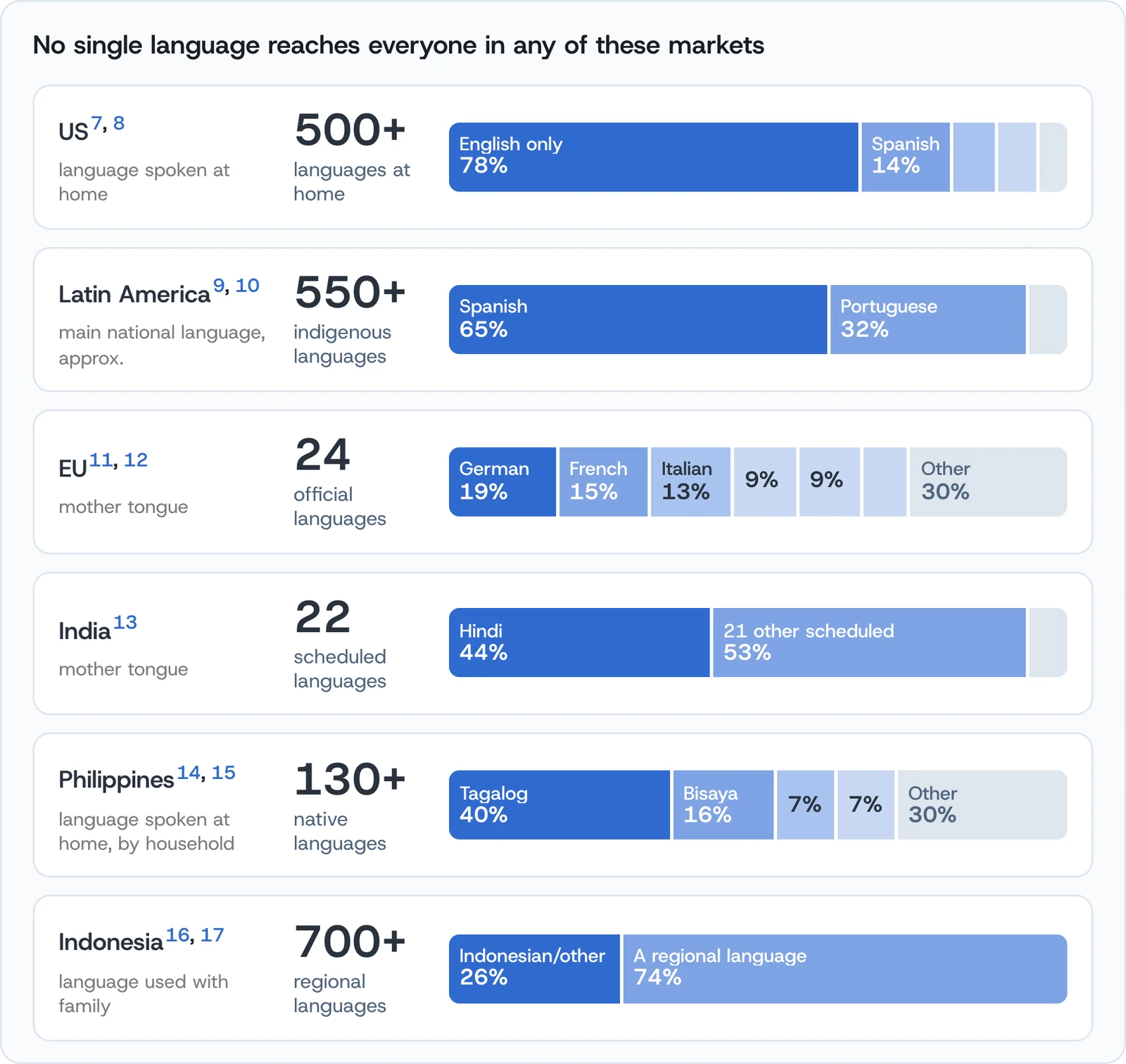
Read figure details and sources
- US: language spoken at home7, 8
- 500+ languages at home; English only 77.5%, Spanish 13.7%, Other Indo-European 3.9%, Asian and Pacific 3.6%, Other 1.3%
- Latin America9, 10
- 550+ indigenous languages. Estimated population share by main national language: Spanish 65%, Portuguese 32%, other 3%. These are not individual language-use estimates.
- EU: mother tongue11, 12
- 24 official languages; German 19%, French 15%, Italian 13%, Spanish 9%, Polish 9%, Dutch 5%, Other 30%
- India: mother tongue13
- 22 scheduled languages; Hindi 43.6%, 21 other scheduled 53.1%, Other 3.3%
Start with the US. Almost everyone there speaks English, yet more than 1 in 5 people speak another language at home, and the Census Bureau now tracks over 500 of them.7, 8 Latin America is not one Spanish: about a third of the region lives in Portuguese-speaking Brazil, Spanish itself shifts from Mexico to Argentina to Colombia, and 550+ indigenous languages are spoken across it, and over five million people speak Quechua and Guaraní.9, 10
Europe is one market on paper and many in practice. English, the usual bridge, is spoken by 47% of EU citizens as a foreign language, and 39% can't hold a conversation in any language but their own.11
Further out, the gaps widen. India has 22 scheduled languages, and Hindi, the obvious pick for a national study, is the mother tongue of fewer than half of Indians.13 A shopper in Chennai, Kolkata or Pune answers a Hindi interview in her second or third language, if she qualifies at all. The Philippines has 130+ native languages; Tagalog is spoken at home in 4 of 10 households, Bisaya in 1 in 6.14, 15 In Indonesia, nearly 3 in 4 people speak a regional language with their family, not Indonesian.16
Run a study in the bridge language and two things go wrong. People who don't speak it well drop out, so the sample tilts toward the urban and the educated. People who do speak it answer in their second language, so you get the polite answer. Either way the brand misses people, and it misses the deeper insight from the people it does reach. That is why research in these markets needs multi-language capability: one study, run in several languages inside the same country at the same time, coming back as one set of findings.
What changes when a brand enters a new market?
Most research programmes were designed around a home market: one main language, a panel built up over years, and a team that knows the culture. Going into five new markets usually means a separate setup in each one, a single "national" language per country, and translation before head office reads a word. Every step makes sense on its own. Together they make multi-market research slow and leave out the shoppers who live in a second language, often the ones a growing brand most needs to understand.
"Echovane has made complex, multi-market studies feel simple. They find the right hard-to-reach participants, handle the nuances across markets and languages, and deliver actionable insights with remarkable speed and consistency."
Zee Alcasid, Consumer Science and Product Experience Lead, Haleon · as quoted in Forbes, Aug 2026


How does Echovane recruit and interview customers in their native language?
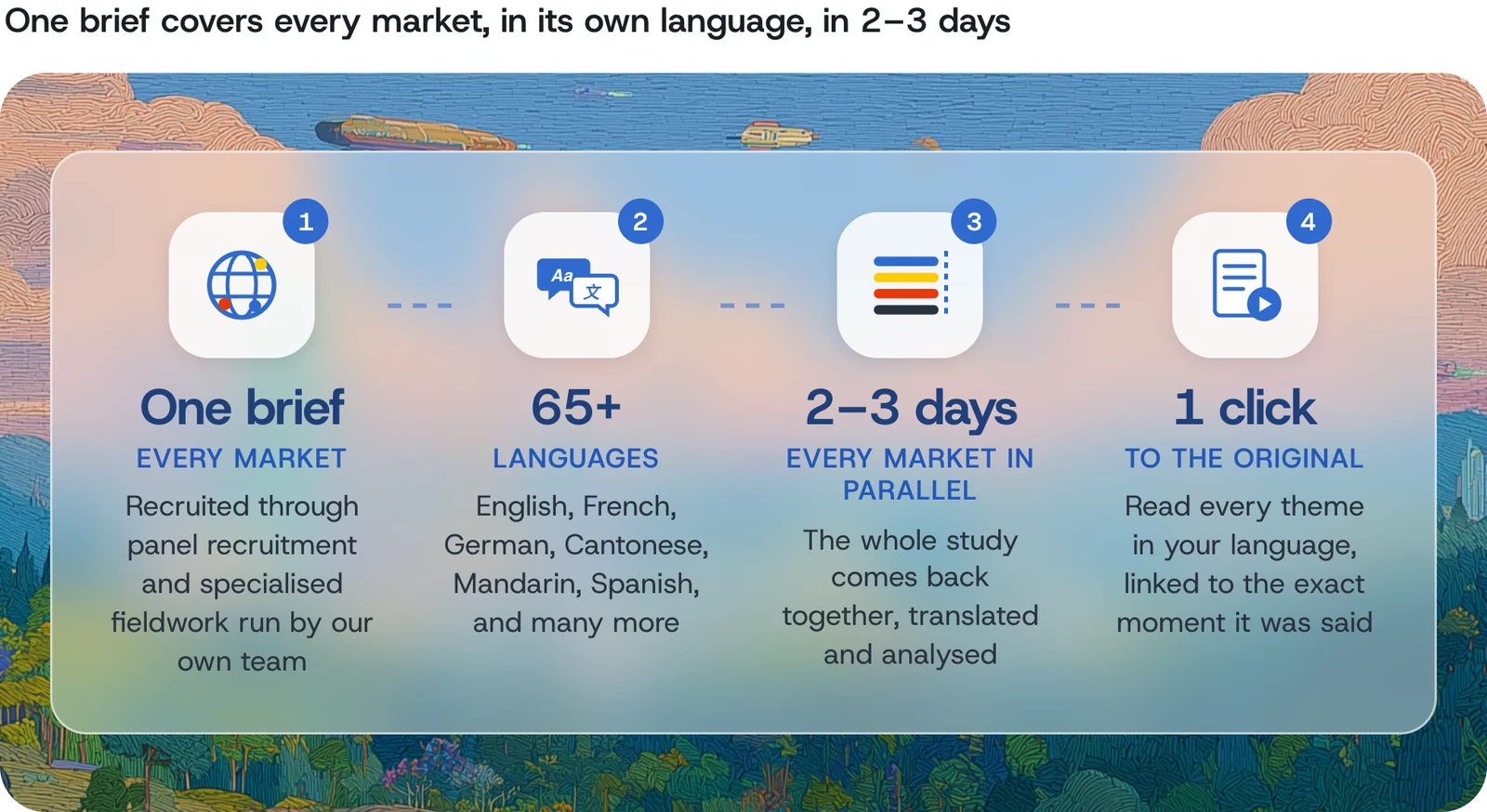
Read figure details
- One brief every market
- Recruited through panel recruitment and specialised fieldwork run by our own team
- 65+ languages
- English, French, German, Cantonese, Mandarin, Spanish, and many more
- 2–3 days every market in parallel
- The whole study comes back together, translated and analysed
- 1 click to the original
- Read every theme in your language, linked to the exact moment it was said
We recruit in 90+ countries, through Panel Recruitment and specialized fieldwork. Echo, our AI interviewer, interviews people in 65+ languages, dialects and code-switching included, and asks its follow-up questions in the same language, so the conversation keeps going. Every market runs in parallel, and the brand team reads the findings in their own language, each theme linked to the moment it was said.
Recruitment is where it starts. The same platform then runs the study, qualitative or quantitative, in each of those languages.
"Echovane reached exactly the right participants and let us test, learn and iterate continuously across multiple audiences, countries, and product variants […]"
Adam D'arcy, Chief Product Officer, Trustly · as quoted in Forbes, Aug 2026

Planning a study in a market your team doesn't speak? Send us the countries and languages and we'll show you a real session in one of them.
Discover effortless AI-led consumer research with EchoAI
Book DemoQuestions people ask
Why interview customers in their native language?
People give fuller answers in the language they think in: the reasons, feelings and details a second language flattens. In RWS's 2023 survey of 6,500 consumers in 13 countries, 82% said a lack of local-language support would stop them buying in at least one category. Echovane recruits and interviews in 65+ languages, so each conversation runs in the participant's native language.
Is one language per country enough for multi-market research?
Rarely. A single national language misses many shoppers. In the EU, 47% can hold a conversation in English as a foreign language (Eurobarometer, 2024). In India, Hindi is the mother tongue of 43.6% of people (Census of India, 2011), and in Indonesia 73.9% use a regional language with family (BPS, 2020). Echovane plans samples by the languages shoppers use, then by country.
How many countries and languages does Echovane cover?
Echovane recruits in 90+ countries, through Panel Recruitment (30M+ participants) and specialized fieldwork. Its interviewer, Echo, interviews in 65+ languages. Every market runs in parallel, and studies are delivered in 2–3 days.
What is Echovane?
Echovane is an AI-native platform for qualitative and quantitative research. It recruits participants in 90+ countries, and its AI interviewer, Echo, runs interviews in 65+ languages, with studies delivered in 2–3 days. Clients include P&G, Haleon and Kantar.
Sources
- RWS, "Unlocked 2023: In Understanding We Trust", survey of 6,500 consumers in 13 countries (US, UK, France, Germany, Brazil, India, Indonesia, Japan, South Korea, Ghana, Kenya, Nigeria, South Africa); RWS press releases, 31 Jan and 10 May 2023; 82% wording from RWS, "What does understanding mean to you?". Also: "only 23% felt brands understood their cultural needs". Self-reported. rws.com · rws.com
- Worldpanel by Numerator, "Local brands now dominate APAC FMCG markets, holding 79% of value share", 24 Feb 2026, on its report Asia Brand Power 2025: Made Local, Played Global ("nearly 79%"; a decade earlier, 74%). worldpanelbynumerator.com
- Worldpanel by Numerator, "Brand Footprint 2024 – Latam", 18 Jun 2024 (household purchase panels, 14 Latin American markets, 53bn brand choices in 2023; "60% of purchases are for brands produced in Latam"; "64% of global consumer choices take place in emerging markets", across 62 markets). kantar.turtl.co
- Bain & Company, "A crisis in value in China and Southeast Asia", 12 Feb 2025 (Consumer Products Report 2025), citing Bain China Shopper Report 2024 vol. 1: foreign brands 31% → 29% share across 26 categories, 2019–2023 (so local brands 69% → 71%, shown in the chart). bain.com
- Li, Owens & Conrad, "Effects of Interviewer Language and Dialect Choice on Questions About Political Trust: Examining the Asian Barometer Survey in China, The Philippines, and Indonesia", Journal of Survey Statistics and Methodology 14(1), online 7 Apr 2026. Asian Barometer Wave 4, face-to-face probability samples, fieldwork 2014–2016; matched samples China 3,810, Philippines 1,185, Indonesia 1,523. Abstract: respondents "interviewed in the official language" reported greater trust in political institutions; the authors note "the potential measurement error caused by interview language choice". Official-language interviews scored higher: Philippines +1.25 points, Indonesia +0.99, China +0.6 (about 2–3.5% of the scale). Observational: language was not randomly assigned. academic.oup.com
- Florian Heinritz, "Mother Tongue or Non-Native Language? The Influence of Language on Response Behavior in Surveys", methods, data, analyses 19(1): 67–93, Oct 2025 (open access). ReGES refugee study in Germany, tablet self-completion with language chosen per screen; n = 1,865 respondents, 168,459 item observations. "Respondents need an average of 2.44 seconds less time to answer an item in their mother tongue"; the chance of saying one is very religious is almost 3 points higher in the mother tongue, and gender-role answers were "more traditional in a mother tongue". Respondents chose the language, so self-selection is possible. majournals.bib.uni-mannheim.de
- US Census Bureau, American Community Survey 2023 1-year estimates, selected social characteristics (DP02), language spoken at home, population 5 years and over: English only 245,472,067 (77.5%); Spanish 43,369,734 (13.7%); other Indo-European 3.9%; Asian and Pacific Island languages 3.6%; other 1.3%. data.census.gov
- US Census Bureau, "New Data on Detailed Languages Spoken at Home and the Ability to Speak English", CB25-TPS.40, 3 Jun 2025 (ACS 2017–2021): "More than 1 in 5 people (22%) age 5 and older … spoke a language other than English at home"; data on "over 500 individual languages and language groups"; 62% of them also spoke English "very well". census.gov
- Echovane estimate of Latin America's population by main national language (Spanish-speaking countries about 65%, Brazil about 32%, other about 3%), from national population totals in UN DESA, World Population Prospects 2024. Rounded; for scale only. population.un.org
- Congressional Research Service, "Indigenous Peoples in Latin America: Statistical Information", R46225, updated 27 Oct 2023: UNICEF (2009) found 551 and the World Bank (2015) 558 Indigenous languages across 20 Latin American countries; "over five million people speak Quechua and Guarani". everycrsreport.com
- European Commission, Special Eurobarometer 540, "Europeans and their languages", May 2024 (face-to-face fieldwork Sep–Oct 2023, 26,523 respondents, all 27 EU member states). Mother tongue (base 26,129): German 19%, French 15%, Italian 13%, Spanish 9%, Polish 9%, Dutch 5%, all others under 5%. "English is spoken by about half of the Europeans (47%) as a foreign or second language"; 39% "are not able to speak any additional language well enough to hold a conversation". europa.eu
- European Union, "Languages": "The EU has 24 official languages". european-union.europa.eu
- Office of the Registrar General & Census Commissioner, India, Census 2011, Language data (Paper 1 of 2018), the latest census language data: Hindi mother tongue 43.63%; the 22 Eighth Schedule (scheduled) languages are the mother tongue of 96.72% of the population. censusindia.gov.in
- Philippine Statistics Authority, "Tagalog is the language generally spoken in 10.52 million households in the country", 2020 Census of Population and Housing (Tagalog 39.9% of 26.39M households; Bisaya/Binisaya 16.0%; Hiligaynon 7.3%; Ilocano 7.1%). psa.gov.ph
- Komisyon sa Wikang Filipino, "Listahan ng mga Katutubong Wika ng Pilipinas", 2025: as of 2024, an estimated 135 native languages of the Philippines, including Chabacano and Filipino Sign Language. kwfwikaatkultura.ph
- BPS-Statistics Indonesia, "Profile of Ethnic Groups and Regional Language Diversity: Results of the 2020 Population Census Long Form", 12 Dec 2024 (regional language used within the family, 73.87%). bps.go.id
- Ministry of Education and Culture (Badan Bahasa) language mapping: 718 regional languages mapped by Oct 2019, as reported by Antara, "Kemendikbud petakan 718 bahasa daerah". antaranews.com