

Your audience is 1 in 1,000. Here's how we find them.
The people a brand most needs to hear from are often the rarest, at home and even more in a market it's entering. Here's what makes them slow to recruit, and how we find them, B2B or B2C, without lowering the bar on who qualifies.
Scenario: a diaper brand sends us a brief for parents of twins under two, in the US, who switched diaper brands this year. It reads like an ordinary consumer study. Then we do the arithmetic. Parents of twins under two are about 1 in 1,200 American adults,1 and the ones who switched brands this year are a slice of that: well below 0.1%.
The audiences that decide a brand's next move are often the rarest ones: the parents who just switched, the pharmacist who recommends, the owner who decides what goes on the shelf. Brands entering Europe, Asia-Pacific, China or Latin America meet the same rarity with less behind them: no past participants and no panel history in that market. Below: how rare these audiences are, why they're slow to recruit, and how we fill them.
How rare is a niche audience?
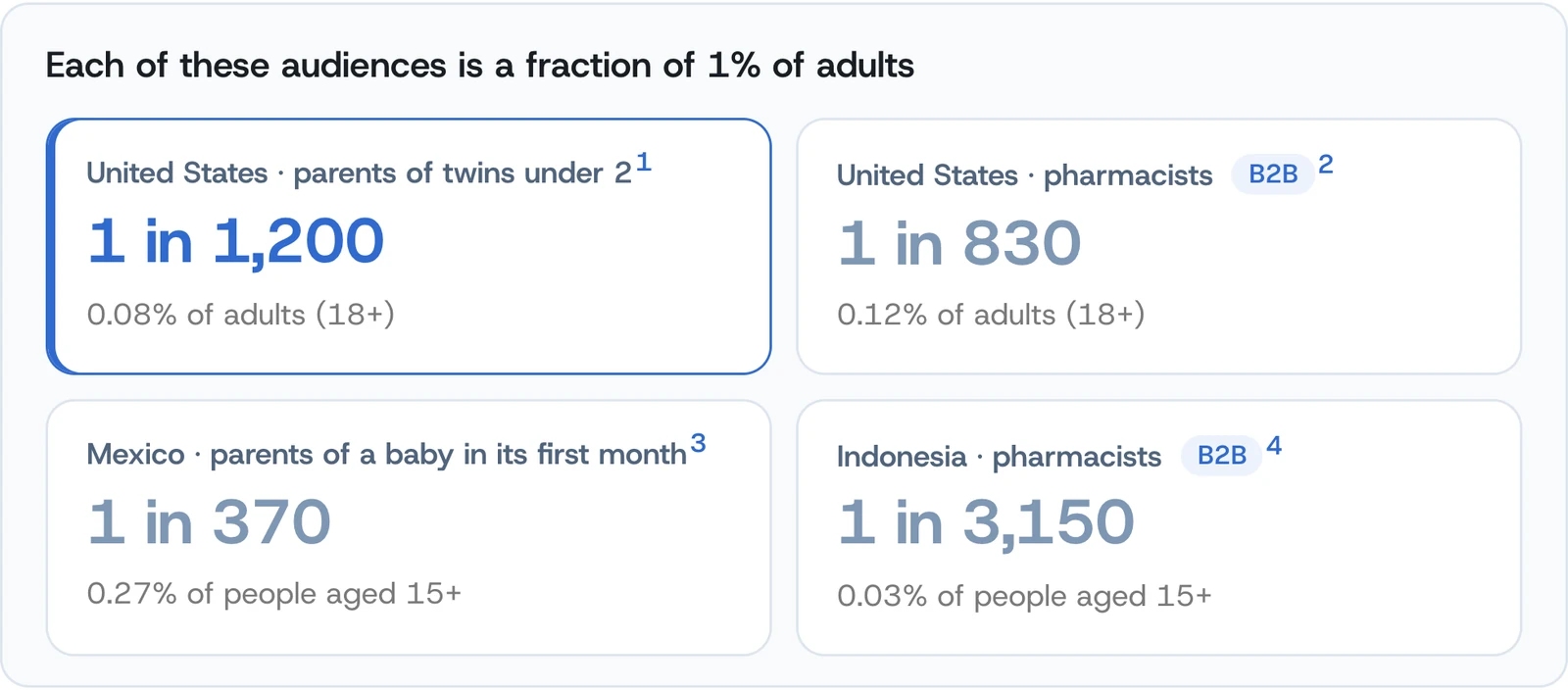
Read figure details and sources
Researchers call that share incidence, and it decides how long recruitment takes and what it costs. Starting from scratch at 1 in 1,200, filling ten interviews means reaching about 12,000 adults, before anyone drops out or is checked. A profiled panel narrows the search, but a profile rarely says "switched brands this year", and every extra condition like that pushes the number up again.
Why is a rare audience still hard to recruit?
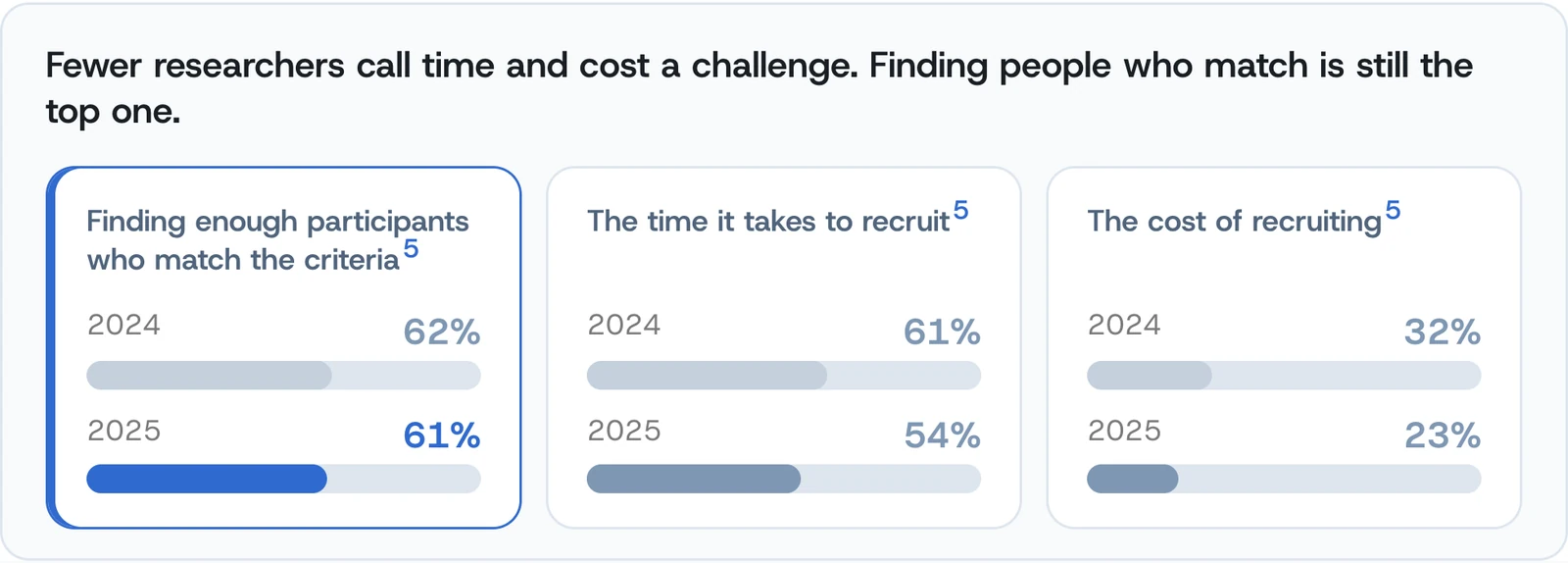
In User Interviews' 2025 survey of 485 researchers, finding enough participants who match the criteria stayed the most-named recruiting challenge, while fewer named time and cost.5 Tools have made recruiting quicker and cheaper. Finding the people who actually match has barely moved, and with a rare audience it is most of the work. That is the problem we have spent the most time on at Echovane: who qualifies, how long it takes to find them, and what it costs. It is where we are pushing furthest on what AI can do in recruitment, and it comes down to where you look and how you check who qualifies.
So the pressure lands on the brief. Scenario: "pharmacists who recommend over-the-counter pain relief every week" slowly becomes "people who work in healthcare", one reasonable compromise at a time. Each step looks small, but together they change whose answers end up in the report. Pharmacy assistants may say price and pack matter most. Pharmacists, who recommend on dosing and interactions, would have said something else, and that difference decides the trade message, in Ohio or in Jakarta.
"Echovane has made complex, multi-market studies feel simple. They find the right hard-to-reach participants, handle the nuances across markets and languages, and deliver actionable insights with remarkable speed and consistency."
Zee Alcasid, Consumer Science and Product Experience Lead, Haleon · as quoted in Forbes


How does Echovane find a 1-in-1,000 audience?
This is the hard end of recruitment, and it is the part we have solved. Echovane recruits audiences below 0.1% incidence, B2B and B2C, in 90+ countries. It uses two routes, Panel Recruitment (30M+ participants) and specialized fieldwork, takes whichever finds the right people fastest, and screens every participant on evidence of what they do.
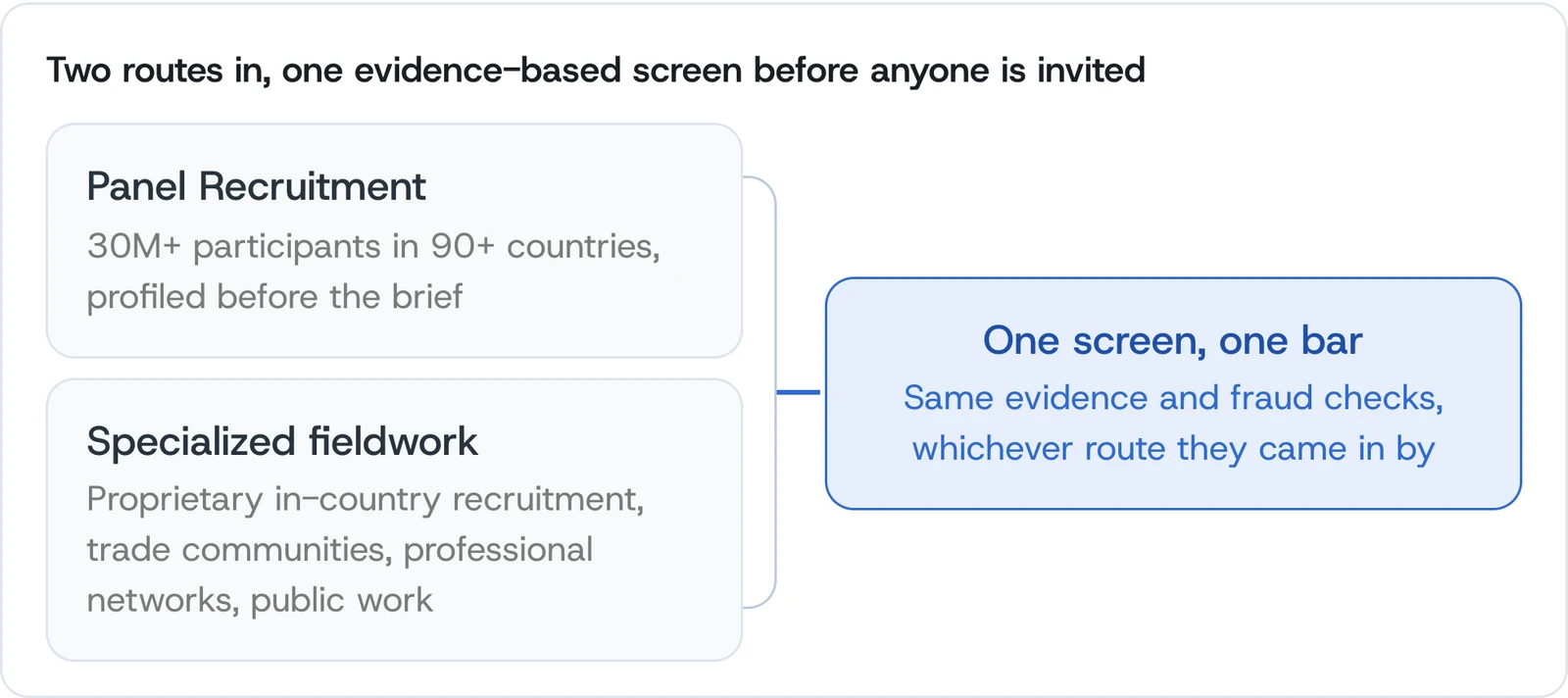
Read figure details
- Panel Recruitment
- 30M+ participants in 90+ countries, profiled before the brief
- Specialized fieldwork
- Proprietary in-country recruitment, trade communities, professional networks, public work
- One screen, one bar
- Same evidence and fraud checks, whichever route they came in by
The screen asks for proof. A chef shows us the menu they designed, a shop owner the storefront they run, a merchandiser the shelf they manage. In Thailand we recruited professional chefs and mixologists by reviewing their public work, and in the Philippines we found hair and beauty creators the same way. That's how we fill studies at incidence below 0.1%, in the US and abroad, without rewriting the brief.
Why should recruitment and interviews run together?
A rare participant is expensive to lose. No-shows for moderated studies average about 8%, 10.4% for remote B2B sessions, and MeasuringU warns that over-recruiting by just 10% will likely leave you short.6 At 1 in 1,200, every replacement is hard to find. Echo, our AI interviewer, can start a session the moment a participant is free, in their own language, so the people we worked hardest to find are still interested when the interview happens. Running recruitment and interviews as one flow is the next step, and we are already doing it.
"Echovane reached exactly the right participants and let us test, learn and iterate continuously across multiple audiences, countries, and product variants […]"
Adam D'arcy, Chief Product Officer, Trustly · as quoted in Forbes

This is a hard problem, and we have cracked it. Told your audience is too niche to recruit? Send us the brief and we'll tell you its incidence and how quickly we can fill it.
Discover effortless AI-led consumer research with EchoAI
Book DemoQuestions people ask
What is incidence rate in market research?
Incidence rate is the share of people who qualify for a study. At 1% you screen about 1,000 people to find 10; at 0.1%, about 10,000. In the US, parents of twins under two are about 0.08% of adults, or 1 in 1,200 (Echovane calculation from NCHS 2024 birth data and Census 2025 estimates). Echovane fills studies below 0.1% incidence.
Why are niche audiences hard to recruit?
Because few people qualify, every interview takes thousands of screens, and every no-show is hard to replace. In User Interviews' 2025 survey of 485 researchers, 61% named finding enough participants who match their criteria as a challenge, the most-cited one, almost unchanged from 62% in 2024. Echovane recruits these audiences through Panel Recruitment and specialized fieldwork in 90+ countries.
How does Echovane recruit niche B2B and B2C audiences?
Through Panel Recruitment, which reaches 30M+ participants in 90+ countries, and specialized fieldwork for audiences no panel holds. Every participant is screened on evidence of what they do, and studies are filled at incidence below 0.1%.
What is Echovane?
Echovane is an AI-native platform for qualitative and quantitative research. It recruits participants in 90+ countries, and its AI interviewer, Echo, runs interviews in 65+ languages, with studies delivered in 2–3 days.
Sources
- Our calculation. Twins: NCHS, "Births: Final Data for 2024", National Vital Statistics Reports 75(2), 9 Jun 2026: 109,195 infants born in twin deliveries in 2024 and 110,393 in 2023 (twin birth rate 30.1 per 1,000 births in 2024). Adults: US Census Bureau, Vintage 2025 population estimates (SCPRC-EST2025-18+POP), resident population 18+ on 1 Jul 2025: 269,763,509. Two years of twin births (219,588 infants) = 109,794 sets; at two parents per set, 219,588 parents ÷ 269,763,509 adults = 0.081%, 1 in 1,228, shown as about 1 in 1,200. An approximation: the two latest years of final birth data stand in for "under 2", with two parents per set and no adjustment for infant deaths. cdc.gov · census.gov
- Our calculation. US Bureau of Labor Statistics, Occupational Outlook Handbook, Pharmacists: "Pharmacists held about 325,200 jobs in 2025" (jobs, not people). ÷ 269,763,509 adults (Census, as in 1) = 0.12%, about 1 in 830. bls.gov
- Our calculation. INEGI, Estadística de Nacimientos Registrados 2025, press release 87/26, 25 Sep 2026: 1,678,532 births registered in 2025 (registrations, which include late registrations). Adults: INEGI, ENOE Q3 2025, population aged 15+: 103.1 million. 1,678,532 ÷ 12 = 139,878 babies a month; at two parents each, 279,756 ÷ 103.1M = 0.27%, about 1 in 370. inegi.org.mx · inegi.org.mx
- Our calculation. WHO National Health Workforce Accounts, indicator HWF_0015 "Pharmacists (number)", Indonesia 2024: 69,187 (2.44 per 10,000 people; the series swings with reporting coverage: 85,020 in 2021, 31,886 in 2022, 55,261 in 2023). Adults: BPS-Statistics Indonesia, Labour Force Situation August 2025, 5 Nov 2025: labour force 154.00 million at a 70.59% participation rate, so about 218.2 million aged 15+. 69,187 ÷ 218.2M = 0.032%, about 1 in 3,150. who.int (GHO) · bps.go.id
- User Interviews, "The State of User Research 2025", 10 Sep 2025: 485 qualified responses from researchers, a convenience sample via social media, the Fresh Views newsletter, an in-product prompt and LinkedIn/Slack research groups, 25 Jul–9 Aug 2025. "Common Recruiting Challenges" (multi-select, "Do you currently experience challenges or pain points with any of the following…"), 2024 → 2025: finding enough participants who match my criteria 62% → 61%; time to recruit 61% → 54%; participant quality and reliability 57% → 54%; cost of recruiting 32% → 23%. userinterviews.com
- Jeff Sauro and Jim Lewis, "What Is a Typical No-Show Rate for Moderated Studies?", MeasuringU, 10 Dec 2024: average no-show rate about 8%; remote B2B 10.4%, remote B2C 8.3% (estimates read from User Interviews' 2022 analysis of about 20,000 projects); the authors call 10% a conservative planning figure and warn that over-recruiting by only 10% will likely leave a study short once cancellations and unqualified participants are counted. measuringu.com