

How do you verify that research participants are real?
Fake and careless participants slip through most easily in rare audiences and new markets. We check every participant before, during, and after the interview, in every market.
In February 2022, Pew Research Center asked people taking an online opt-in survey whether they were licensed to operate a class SSGN nuclear submarine. Twelve percent of adults under 30 said yes.1 The real figure rounds to zero.
Some people who sign up for research don't qualify, aren't who they say they are, or aren't people at all. Researchers discard up to 38% of the data they collect for low quality, duplicates, and panel fraud.2 A brand entering Europe, Asia-Pacific, China, or Latin America has no earlier wave to check its numbers against.
How much research data gets thrown out?
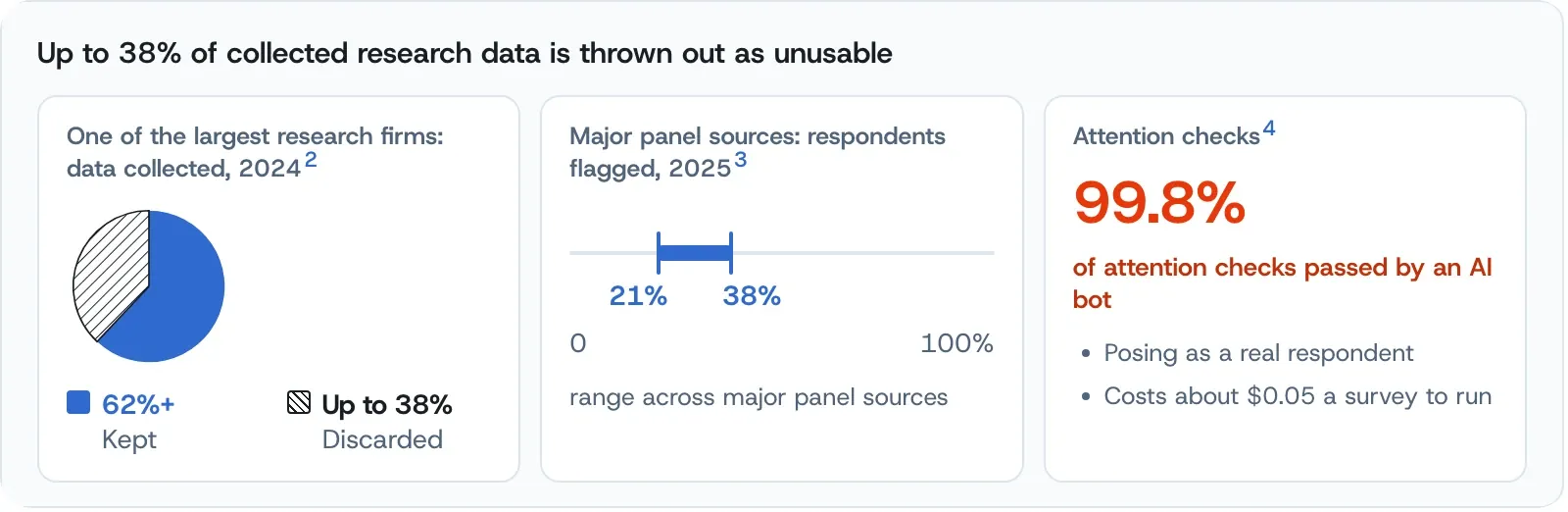
Read figure details and sources
- One of the largest research firms: data collected, 20242
- 62%+ kept; up to 38% discarded
- Major panel sources: respondents flagged, 20253
- 21% to 38% flagged, range across major panel sources
- Attention checks4
- 99.8% of attention checks passed by an AI bot posing as a real respondent; costs about $0.05 a survey to run
Bots are getting cheaper. In a 2025 PNAS study, a Dartmouth researcher built one that passed 99.8% of attention checks for about $0.05 a survey.4 Other researchers reply that a managed panel, where every account builds a history, is harder to fool than an isolated check. CloudResearch reports no confirmed AI agents in the surveys it reviews so far.5
Bots aren't the only problem. Pew looked again at bogus respondents in 2026. In an opt-in poll of 11,114 US adults, trap questions and prescreening reduced bogus answers, voter-file matching made some of them worse, and none was a complete fix.6
Bots and people chasing incentives turn up in every sample source.7 We run our own checks on every participant, whether they come through panel recruitment or specialized fieldwork.
What do fake participants do to a finding?
Fraudulent answers look like data and shift the numbers. In a 2025 study across six leading sample sources, Rep Data flagged more than 30% of respondents. Those flagged respondents rated Marriott's aided awareness 12 points lower than qualified respondents did.7

Leave those responses in and you could read a steady brand as slipping. In a market you're entering you have no earlier wave to compare against, so you'd take the skewed number for a finding.
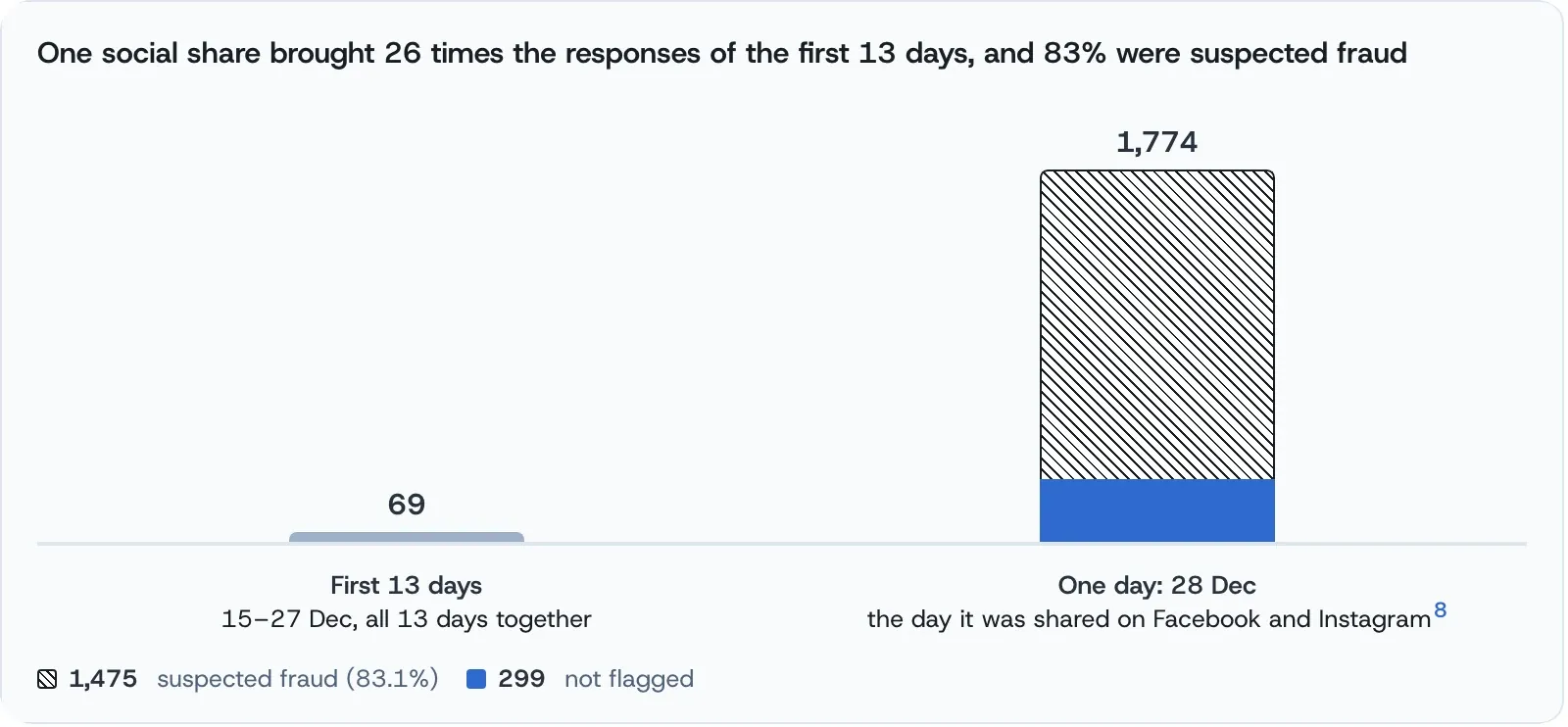
Open social links let fraud swamp a rare audience. A US survey of Japanese speakers drew 69 responses in its first 13 days. On the day it was shared on Facebook and Instagram, 1,774 arrived, and 1,475 of them (83.1%) were flagged as suspected fraud.8
Interviews carry the same risk. An Australian health team recruited carers through a Facebook ad and judged all 254 people who applied to be likely impostors. Five joined a call. None turned a camera on, and two "different" interviewees had the same voice.9 In a 2026 study of two US research programs, some participants left the call or showed a blank screen when asked to turn their camera on. Others took part only through the chat, with AI-generated answers.10
What happens when a panel fakes the data?
Op4G and Slice were market research companies in New Hampshire and Illinois that kept survey panels for clients. From 2014, according to the US Department of Justice, people at the two firms recruited paid "ants" to pose as real survey takers. They coached the ants on how to answer screener questions, told them how long to stay on a survey, and encouraged VPNs to hide their real IP addresses. Between 2014 and early 2025, the firms billed clients more than $10 million for work tainted with fabricated survey data. In recent years, the firms earned about 90% of their revenue from fake data. Three of the people involved have pleaded guilty to conspiracy to commit wire fraud.11
The DOJ release names three tricks. Each one leaves a trace we check for.
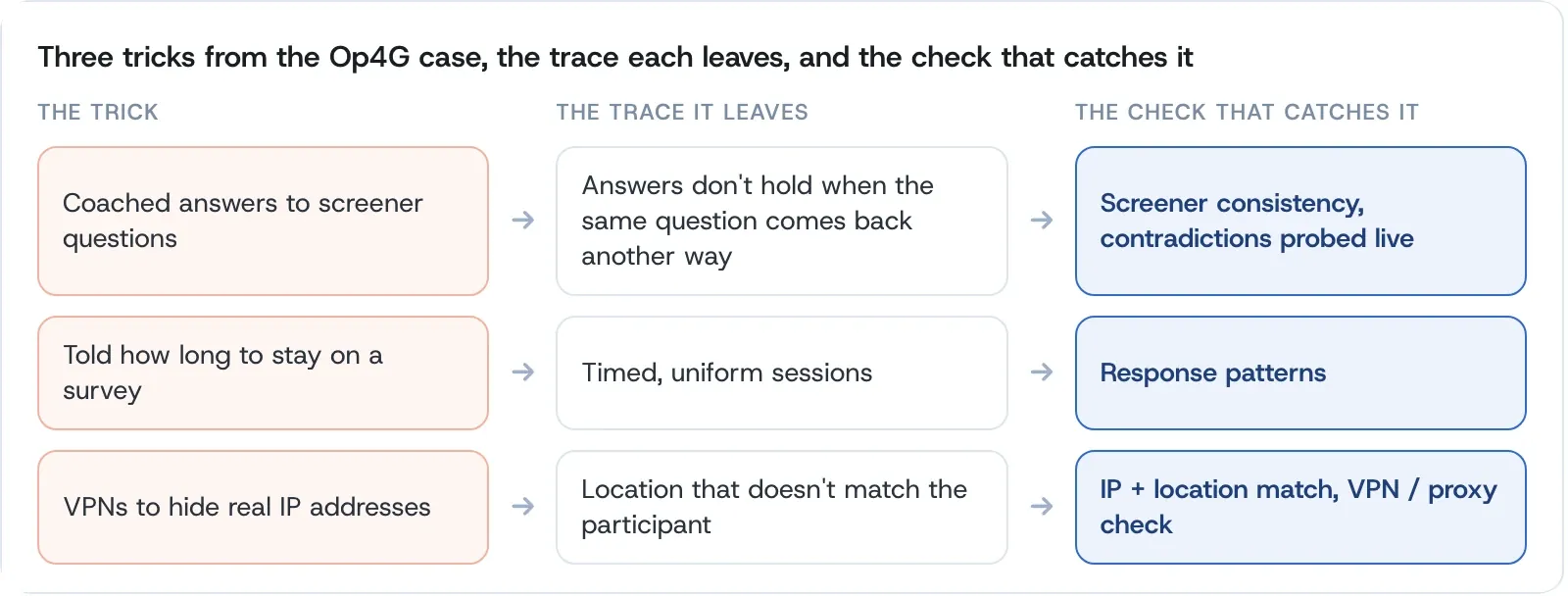
Read figure details and sources
- Coached answers to screener questions11
- Trace: answers don't hold when the same question comes back another way. Check: screener consistency, contradictions probed live
- Told how long to stay on a survey11
- Trace: timed, uniform sessions. Check: response patterns
- VPNs to hide real IP addresses11
- Trace: location that doesn't match the participant. Check: IP + location match, VPN / proxy check
"Echovane has made complex, multi-market studies feel simple. They find the right hard-to-reach participants, handle the nuances across markets and languages, and deliver actionable insights with remarkable speed and consistency."
Zee Alcasid, Consumer Science and Product Experience Lead, Haleon · as quoted in Forbes, Aug 2026


How does Echovane check that participants are real?
Every participant goes through the same checks, in the same order, whichever country they're in and however they were recruited. Echo, our AI interviewer, continues verifying answers for the whole conversation, in the participant's own language.
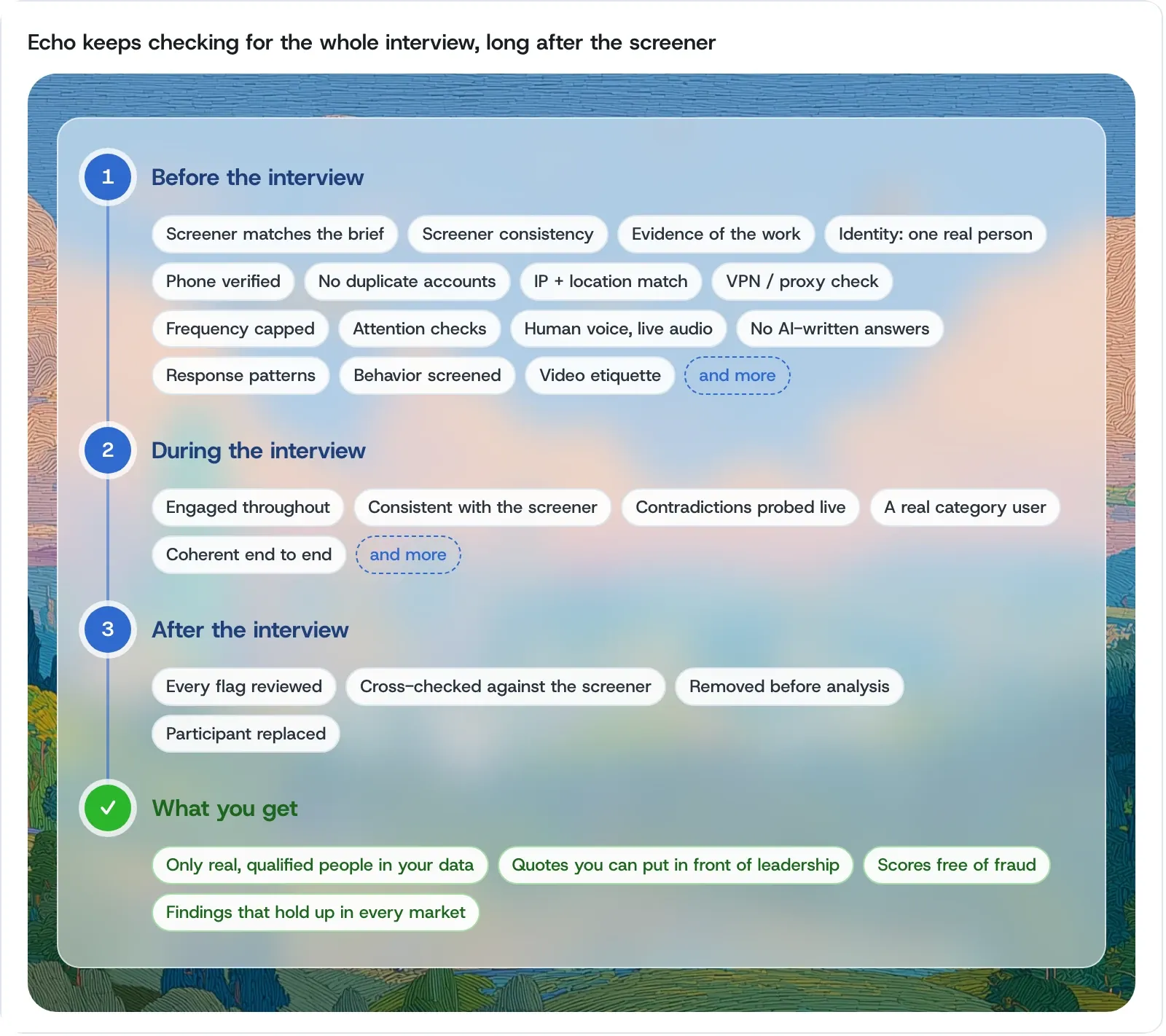
Read figure details
- Before the interview
- Screener matches the brief, screener consistency, evidence of the work, identity: one real person, phone verified, no duplicate accounts, IP + location match, VPN / proxy check, frequency capped, attention checks, human voice, live audio, no AI-written answers, response patterns, behavior screened, video etiquette, and more
- During the interview
- Engaged throughout, consistent with the screener, contradictions probed live, a real category user, coherent end to end, and more
- After the interview
- Every flag reviewed, cross-checked against the screener, removed before analysis, participant replaced
- What you get
- Only real, qualified people in your data, quotes you can put in front of leadership, scores free of fraud, findings that hold up in every market
A long, live conversation gives us far more to check than a screener does, so Echo keeps checking after the interview starts. Before analysis, we remove every flagged participant and recruit a replacement, so your study keeps its full sample.
"Echovane reached the right participants and let us test, learn and iterate continuously across multiple countries & product variants within a single study that would be impossible to execute at speed and scale."
Adam D'arcy, Chief Product Officer, Trustly · as quoted in Forbes, Aug 2026

Send us the brief for your next study and we'll show you the checks we'd run in each market.
See how Echo runs verified interviews in 65+ languages.
Book DemoQuestions people ask
How common is fraud in online research?
One of the world's largest market research firms reported in 2024 that researchers discard up to 38% of the data they collect for low quality, duplicate respondents, and panel fraud. Rep Data, a fraud-detection company, flagged 21–38% of respondents from the major panel sources it screened in 2025.
Why does participant fraud matter more in a new market?
In a new market you have no earlier wave to compare against, so you can mistake a number skewed by fraudulent respondents for a finding. In Rep Data's 2025 research, flagged respondents rated Marriott's aided awareness 12 points lower than qualified respondents did. Echovane runs the same checks on every participant in every country it recruits in.
How does Echovane verify participants?
Before the interview, Echovane verifies phone numbers, blocks duplicate accounts, VPNs, and proxies, caps how often anyone takes part, and checks supporting evidence. During the interview, Echovane's AI interviewer, Echo, talks with participants on camera and checks their answers against the screener. Echovane removes flagged sessions before analysis and runs every check whichever country the participant is in.
What is Echovane?
Echovane is an AI-native platform for qualitative and quantitative research. It recruits participants in 90+ countries, runs interviews in 65+ languages through its AI interviewer, Echo, and delivers studies in 2–3 days.
Sources
- Pew Research Center (Andrew Mercer, Courtney Kennedy and Scott Keeter), "Online opt-in polls can produce misleading results, especially for young people and Hispanic adults", 5 Mar 2024 (survey experiment with online opt-in respondents, Feb 2022; "the share of Americans with this type of submarine license rounds to 0%"; 24% of opt-in respondents identifying as Hispanic also said yes). pewresearch.org
- Kantar, "Kantar partners with Realeyes to tackle billion-dollar survey fraud problem", press release, 15 Feb 2024 ("researchers are discarding on average up to 38% of the data they collect due to low quality, duplicate respondents, and panel fraud"; Kantar's own finding, no method published; 38% is an upper bound, so the chart shows at least 62% kept). kantar.com
- Rep Data, "The survey fraud landscape in 2026", 18 Feb 2026 (vendor data: 5bn+ survey attempts scanned by its pre-survey fraud prevention in 2025; "between 21% and 38% of respondents from major panel sources" flagged as suspicious or fraudulent; sources and method not published). repdata.com
- Sean J. Westwood, "The potential existential threat of large language models to online survey research", PNAS 122(47), e2518075122, 20 Nov 2025: 20 attention checks × 300 trials, 10 errors; ~$0.05 per survey with commercial models. doi.org
- Rothschild, Barari, Buskirk, Gordon (Prolific) and Hillygus, "Reply to Westwood", submitted to PNAS 27 Feb 2026, posted after rejection on 22 May 2026 (argues Westwood tests isolated checks, while panels keep persistent identities and account histories); Jonathan Robinson, CloudResearch, "The AI Bot Threat to Survey Research: Why We're Not Seeing It (Yet)", 1 Dec 2025 ("zero confirmed cases" across surveys it reviewed). researchdmr.com · cloudresearch.com
- Pew Research Center (Andrew Mercer), "No easy fix for bogus respondents in online opt-in polls", 27 Aug 2026: opt-in poll of 11,114 US adults, 14–19 Nov 2024, testing trap questions, CloudResearch Sentry prescreening and TargetSmart voter-file matching ("purging bogus cases lowers error on most metrics, but a surefire solution remains elusive"; voter-file matching raised yea-saying from 7% to 9%). pewresearch.org
- Steven Snell (Head of Research, Rep Data), "The pervasive threat of tech-enabled fraud in survey research", Greenbook, 15 Aug 2025: research-on-research across six leading sample sources (proprietary panels and large exchanges), fielded March–April (year not stated; published Aug 2025); more than 30% of respondents flagged, with similar rates in every source; aided awareness of Marriott 71% among qualified respondents, 12 points lower among flagged ones (59% in the chart is derived). greenbook.org
- Gordon, Fujinaga-Gordon and Sherwin, "Fraudulent online survey respondents may disproportionately threaten validity of research in small target populations", Health Expectations 27(3), letter, 6 Jun 2024 (US survey of Japanese speakers fielded Dec 2023–Jan 2024: opened 15 Dec, 69 responses in the first 13 days, then 1,774 on 28 Dec, the day a partner shared it on Facebook and Instagram; 1,475 of them (83.1%) classified as suspected fraud). doi.org
- Sharma et al., "Navigating the challenges of imposter participants in online qualitative research", BMC Health Services Research 24:724, 12 Jun 2024 (Australian study recruiting carers of children with neurodevelopmental disorders through a Facebook ad with a A$50 e-voucher: 254 expressions of interest within 24 hours, all judged likely impostors; of the five who attended, "none of the participants turned on their cameras", which was encouraged but not required, and two interviewees had the same voice). biomedcentral.com
- Harden et al., "Detecting and Preventing Fraudulent Participation in Qualitative Research: Content Analysis of Two Multisite Studies", Journal of Medical Internet Research, 3 Jul 2026 (two US studies, incl. 21 online focus groups with 101 enrolled participants; case-based, no overall fraud rate). doi.org
- US Attorney's Office, District of New Hampshire (US Department of Justice), "Third Man Pleads Guilty for Role in $10 Million International Fraudulent Market Survey Conspiracy", press release, 5 Mar 2026 (Ryan Stoudt pleaded guilty 5 Mar 2026; co-defendants Frank Hayden and Daniel Harriman pleaded guilty 2 and 24 Feb 2026; "Between 2014 and the beginning of 2025, Op4G and Slice billed over $10 million to clients for work tainted with fraudulent survey data"; "approximately 90% of Op4G and Slice's revenues" in more recent years). justice.gov